
Business Development Manager
Harish joined the Business Development team at Integrum ESG after having previously overseen BD for the investment network Venture Giants, and also worked within the Customer Experience Program Team at Amazon. He has a BSc in Philosophy, Logic and Scientific Method from the London School of Economics and Political Science.
The European Parliament and EU member states reached a provisional deal on SFDR 2.0 on 19 November 2026, a year after the European Commission published its proposal.
Three new categories, Sustainable, Transition and ESG Basics, will replace the Article 8 and 9 labels used across European fund ranges. According to Reuters, the change could affect around €7.5tn of European funds.
Funds that disclose under Article 8 or 9 today will need to qualify for one of the new categories, or stop using sustainability terms in their names and marketing. The deal sets what each fund will need to show to qualify, and so how much a category will tell investors about the holdings behind it.
Most of the framework is as the Commission proposed. This article sets out what the deal changed, including how principal adverse impacts are reported, whether Transition funds can hold fossil fuel companies and which funds can opt out. It also covers what is still to come on exclusions.
This article compares the Commission's November 2025 proposal with the Council of the EU's summary of the provisional agreement. The legal text has not yet been published, so some details may change.
Managing Article 8 or 9 funds? See how prepared they are for the new SFDR 2.0 categories.
Today's Article 8 and 9 funds will need to qualify for one of three new categories to keep using sustainability terms in their names and marketing. The categories and the 70% threshold are as the Commission proposed.
PAI indicators for Transition and Sustainable funds will come from a common Commission list, with biodiversity mandatory for Sustainable funds.
Fossil fuel companies can be considered for Transition funds if they have a Paris-aligned emissions plan, allocate 20% of their capex to EU Taxonomy-aligned activities and raise that share over time.
AIFs sold only to professional investors can be left out of categorisation, with safeguards for retail investors.
Exclusion lists are still to be published, and the rules apply two years after publication in the EU's Official Journal.
The deal
The deal keeps the three categories the Commission proposed:
Sustainable, the highest category, for products that contribute to sustainability goals
Transition, for products investing in companies or projects that are not yet sustainable but are on a credible path away from unsustainable activities
ESG Basics, for products that may integrate ESG approaches but do not meet the stricter criteria of the other two
The proposal numbers them Article 9 (Sustainable), Article 7 (Transition) and Article 8 (ESG Basics). The numbers overlap with today's Articles 8 and 9, but the tests are new, so a fund's current status will not carry over automatically.
Europe's largest asset managers made the same point at our SFDR 2.0 breakfast: each fund needs its own assessment.
Every categorised fund must invest at least 70% in line with its chosen strategy and exclude harmful industries and activities. Environmental, social and governance claims in fund names and marketing documents will be reserved for categorised products.
The Council presents this as a key step against greenwashing. It notes that the Commission's review found SFDR had effectively become a labelling system, causing confusion for investors, retail investors in particular.
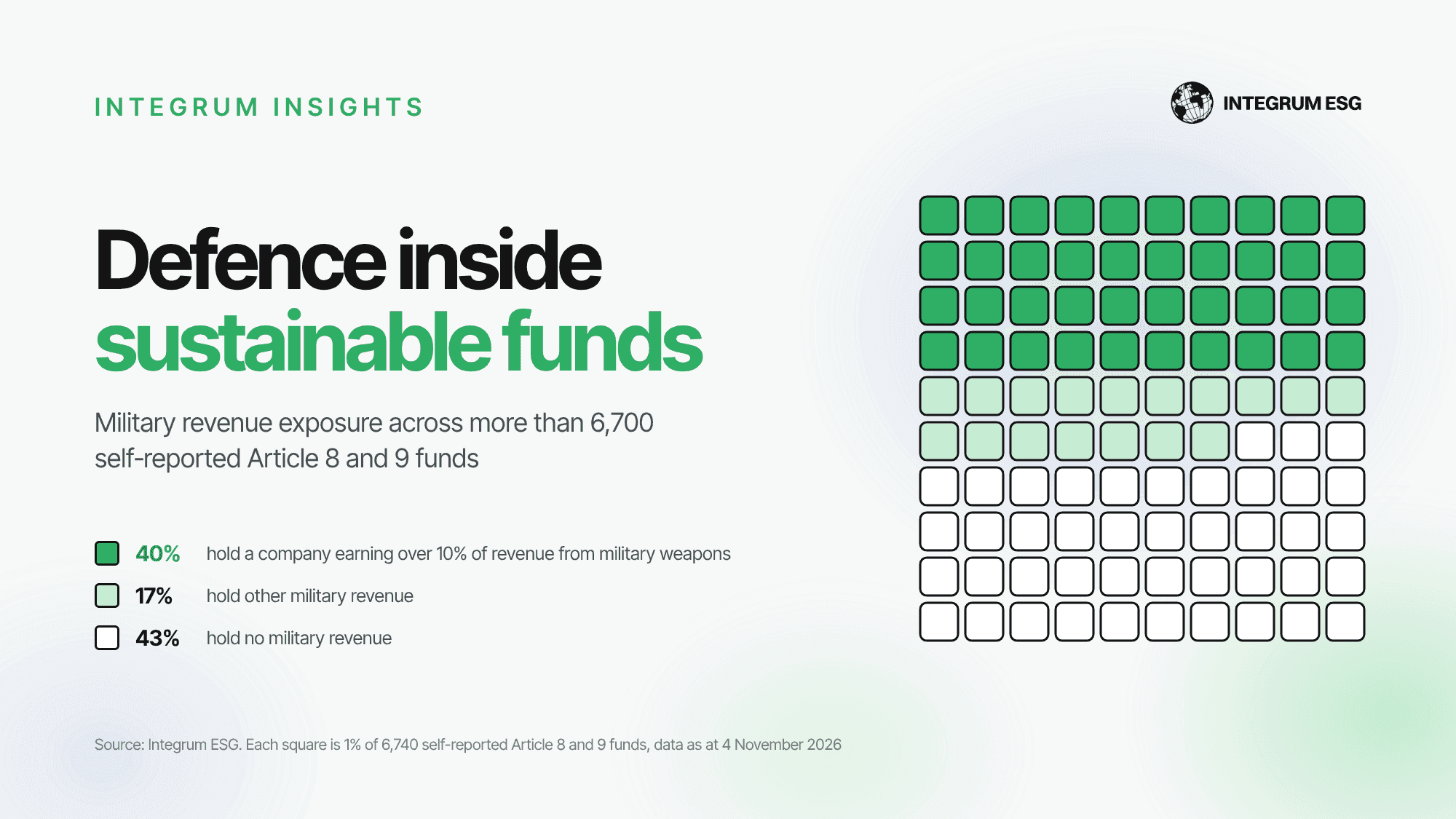
For fund selectors, that makes the category a more reliable first filter. It still sets a minimum, though, and will not show everything a fund holds. Our analysis of defence exposure in self-reported Article 8 and 9 funds showed how far holdings can differ between funds carrying the same label.
To qualify as Transition or Sustainable, a fund will have to identify and disclose its principal adverse impacts using measurable indicators selected from a common list set by the Commission. The Commission's proposal would have let each manager use the indicators it judged appropriate.
Principal adverse impacts (PAIs) are the most significant negative effects an investment has on the environment and society, such as greenhouse gas emissions, fossil fuel exposure, harm to biodiversity or poor labour practices. Under the current SFDR, managers with more than 500 employees must publish an entity-level statement of them.
Some indicators are fixed:
Transition funds: two indicators must relate to fossil fuel use and greenhouse gas emissions
Sustainable funds: greenhouse gas emissions and damage to biodiversity are both mandatory
The Council's reason is comparability. Common indicators make it easier for investors to compare the sustainability impacts of different products.
The European Parliament had pushed for product-level PAI disclosure across all three categories, as we set out in our analysis of Parliament's negotiating position. The Council's summary of the deal sets it as a condition for Transition and Sustainable.
For managers, that means PAI data across the holdings of each fund they want to place in either category, including biodiversity data for Sustainable funds. Integrum ESG's SFDR solution provides PAI data at company level and generates SFDR PAI reports in one click.
The Commission's proposal would have excluded companies developing new fossil fuel projects from Transition funds. Under the deal, companies active in the fossil fuel sector can be considered for the category if they:
have a clear, time-bound strategy to cut greenhouse gas emissions, aligned with the Paris Agreement
allocate 20% of their capital expenditure to EU Taxonomy-aligned activities
increase that share of capital expenditure over time
The Council's stated reason is the role these companies play in the transition. Whether a fossil fuel company can sit in a Transition fund will depend on its own spending and plans.
Managers will need to find every holding with fossil fuel activity and check each one against all three conditions. Integrum ESG's Controversial Activities data shows each company's revenue exposure to fossil fuels, which identifies the holdings that need the check.
Fund selectors should expect some Transition funds to hold fossil fuel companies. Funds Intelligence shows which ones by looking through a fund's holdings to company level.
Managers can choose not to apply the categorisation rules to alternative investment funds (AIFs) offered exclusively to professional investors. The Council's reasoning is that professional investors do not need the same standardised information as retail investors.
The deal includes safeguards so that retail investors do not end up holding these funds indirectly.
The Commission's proposal had no such opt-out. In their negotiating positions, both the Council and the Parliament limited it to AIFs for per se professional clients.
On that basis, it would not cover UCITS funds, pension products or AIFs open to elective professional or retail investors. The legal text will confirm the boundary.
For hedge fund and private markets managers, this could take many funds out of the categorisation regime. Their institutional investors may still ask for the same sustainability data for their own reporting.
Still to come
The Council's summary confirms that every categorised fund must exclude harmful industries and activities, but it does not list them. In the Commission's proposal, the exclusions depended on the category:
ESG Basics: the Climate Transition Benchmark (CTB) exclusions, plus companies with 1% or more of revenue from hard coal and lignite
Transition: the same, plus further fossil fuel exclusions, including companies developing new fossil fuel projects
Sustainable: the stricter Paris-aligned Benchmark (PAB) exclusions, plus the same further fossil fuel exclusions
The deal's conditions for fossil fuel companies in Transition funds will have to sit alongside these. The legal text will show how they fit together and what the final lists contain.
Until then, the proposal's lists remain the best guide for managers mapping their funds.
CTB and PAB exclusions are the lists of companies that the EU's two labelled climate benchmarks must leave out. The EU Climate Transition Benchmark (CTB) sets a baseline. The EU Paris-aligned Benchmark (PAB) adds thresholds for coal, oil, gas and high-carbon power generation.
Both come from Commission Delegated Regulation (EU) 2020/1818. Article 12(1) sets out seven exclusions, points (a) to (g), which PAB administrators must apply in full. Article 10 applies the first three, points (a) to (c), to CTBs.
| Companies excluded | CTB | PAB |
|---|---|---|
| Involved in any activities related to controversial weapons | Excluded | Excluded |
| Involved in the cultivation and production of tobacco | Excluded | Excluded |
| In violation of the UN Global Compact principles or OECD Guidelines for Multinational Enterprises | Excluded | Excluded |
| 1% or more of revenue from exploration, mining, extraction, distribution or refining of hard coal and lignite | Not excluded | Excluded |
| 10% or more of revenue from exploration, extraction, distribution or refining of oil fuels | Not excluded | Excluded |
| 50% or more of revenue from exploration, extraction, manufacturing or distribution of gaseous fuels | Not excluded | Excluded |
| 50% or more of revenue from electricity generation with a GHG intensity above 100g CO2e/kWh | Not excluded | Excluded |
Source: Commission Delegated Regulation (EU) 2020/1818, Articles 10 and 12(1).
PAB administrators must also exclude companies they find or estimate to significantly harm one or more of the EU Taxonomy's environmental objectives.
The lists already shape fund ranges beyond benchmarks. ESMA's 2024 guidelines on fund names apply them according to the terms a fund uses:
CTB exclusions for funds with transition, social or governance terms in their names
PAB exclusions for funds with environmental, impact or sustainability terms
Our guide to ESMA's fund naming rules explains how those guidelines work. The Commission's SFDR 2.0 proposal built its category exclusions on the same two lists.
The gap between the two lists falls mainly on energy holdings. Under the Commission's proposal, Sustainable funds would have applied all four energy thresholds, while ESG Basics and Transition funds applied only the coal threshold.
Our CTB and PAB Exclusions Explained guide covers both lists in more detail. Integrum ESG's Controversial Activities data shows company revenue exposure to the activities on both, including controversial weapons, tobacco and fossil fuels.
The deal still needs formal approval from both the Parliament and the Council. The rules will then be published in the EU's Official Journal and apply two years later, against the 18 months the Commission proposed.
The deal keeps the Commission's framework but changes what a fund must show to sit in the two higher categories. Transition and Sustainable funds will report indicators from the Commission's PAI list, including biodiversity for Sustainable funds.
Fossil fuel holdings in Transition funds will need a company-by-company check against three conditions. Every categorised fund will need exclusion screening once the lists are published.
For asset managers, the two years before the rules apply are the time to map each of today's Article 8 and 9 funds to a new category and find where the data falls short.
For fund selectors, the new categories will make funds easier to compare. A category will still set a minimum, though, so the holdings remain the place to see what each fund owns.
Integrum ESG's SFDR solution, Controversial Activities data and Funds Intelligence provide the PAI indicators, exclusion screening and fund look-through that these tests start from, with coverage of 6mn+ ISINs across companies and funds.
Speak to an expert about mapping your Article 8 and 9 funds to the new SFDR 2.0 categories.
Unlock black boxes and see inside your future investments.


Browse frequently asked questions about the platform.
Can’t find the answer you’re looking for? Please get in touch with our team.