
Shauna joined the BD team at Integrum ESG in 2021, having previously worked in similar roles within Fintech companies. She holds a BA in English and New Media Studies from the University of Limerick, Ireland.
Realty Income, an S&P 500 company held across income and passive portfolios, has 3.1% of its revenue attributed to Casinos and Gambling Establishments.
The gambling flag sits behind a real estate classification, so a screen built purely at an industry level clears ‘The Monthly Dividend Company’ without a second look.
The exposure is real and disclosed all the same, and it is the kind of flag that can matter for a specific client mandate, from a formal exclusion policy to a faith-based or values-based brief.
We screened companies on the Integrum ESG Platform against our Controversial Activities dataset to find others like it: listed names carrying a controversial activity flag their sector would never signal. Three are set out below, spanning gambling and tobacco exposure that reaches a portfolio through property ownership, retail and distribution.
Company data referenced is drawn from the Integrum ESG Platform, powered by Syntax’s Affinity™ data, and is current as at August 2026.
Institutional screening has moved well beyond sector codes.
Most investors now screen on product involvement and revenue thresholds, and rightly so. But involvement data is only as useful as it is precise.
The lesson these companies teach is that exclusion screening has to work at the level of activity, not industry. Many ESG providers and in-house teams rule a company in or out on the sector it sits in. That catches the obvious cases and misses the ones where a controversial activity sits inside a business the sector label describes as something else.
Knowing that a company is flagged for gambling or tobacco is not the same as knowing how large the exposure is, what generates it, and whether it falls inside the exclusion as written.
Without the number and the activity behind it, an exclusion decision is left half-made. The exposure that proves material to a mandate is usually the one that comes from a part of the business the classification never described: rent from a leased property, a distribution contract, a subsidiary two levels down.
A screen that stops at the business classification, or that flags involvement without quantifying it, cannot tell an investor whether the holding belongs in the portfolio, or let them evidence the decision if a client asks.
For the categories most commonly screened and the mandate drivers behind them, see our breakdown of controversial activities.
Read 'Controversial Activities Explained' here.
None of the three companies we flag below runs the activity it is flagged for.
One owns the property a casino operates in; the others sell and distribute tobacco through businesses their sector labels describe as travel retail and logistics. In each case the revenue is real, disclosed, and invisible on a sector screen.
Realty Income is a net-lease real estate investment trust and one of the largest in the world, marketed as ‘The Monthly Dividend Company’. Its membership of both the S&P 500 and the S&P 500 Dividend Aristocrats index, alongside an unusually high share of retail ownership, places it in a large number of income and passive portfolios.

Integrum ESG data attributes 3.1% of its revenue to Casinos and Gambling Establishments. For a net-lease REIT that revenue is rental income, so the exposure is gaming-linked rent rather than casino operating income.
The exposure comes from owning casino property. Realty Income owns the land and buildings under Encore Boston Harbor, acquired from Wynn Resorts for $1.7 billion on a 30-year net lease, and holds an interest in the real estate under the Bellagio on the Las Vegas Strip. The operators run the casinos; Realty Income owns the property and collects the rent.
This is why the revenue is in scope. A casino property is a specialised, licensed, purpose-built asset, dedicated to gaming and leased to the operator, not a service any business could supply to anyone. The rent is derived directly from the gaming premises, which places it inside the activity in the way that generic corporate services, a bank loan to a gambling firm or an advertising slot sold to one, are not.
A policy aimed only at casino operators may still choose to treat a dedicated gaming landlord differently; one that captures any revenue derived from gambling activity would include it. The 3.1% figure, and the fact that it is gaming rent, is what lets an investor make that call rather than miss the exposure entirely.
Request a full risk report on Realty Income (NYSE: O) here.
Avolta is the airport duty-free business, formerly Dufry, running the duty-free and travel-convenience stores found in airports worldwide including World Duty Free and Hudson.
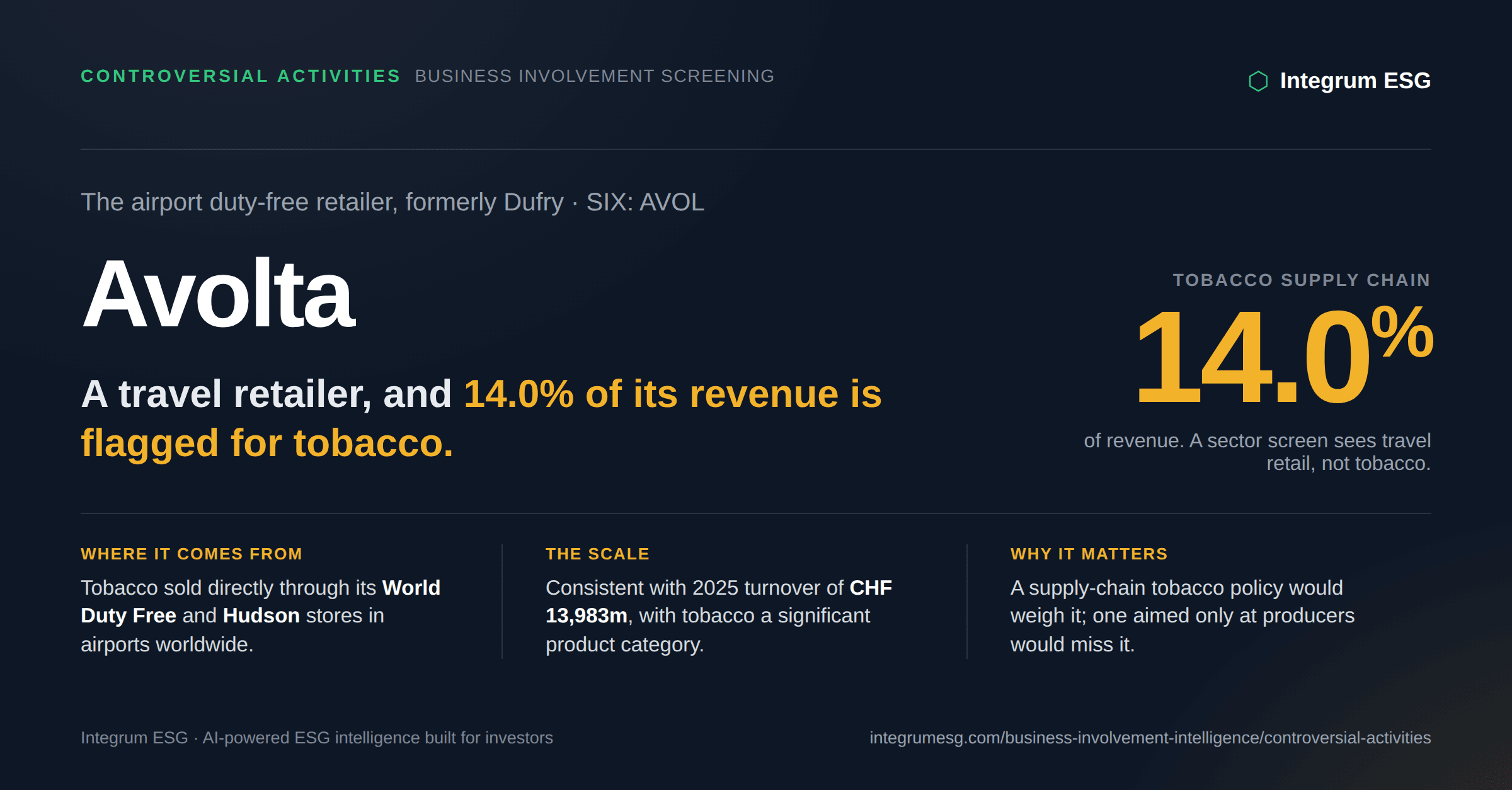
Integrum ESG data attributes 14.0% of its revenue to the tobacco supply chain, sold directly through its stores. The figure is consistent with the company's own 2025 reporting, in which total turnover reached CHF 13,983 million with tobacco a significant product category.
A tobacco policy targeting producers may reasonably retain Avolta; a policy written to capture the supply chain, distribution and retail included, would weigh the 14.0%.
Request a full risk report on Avolta (SIX: AVOL) here.
Logista presents as an integrated logistics and distribution business, serving around 200,000 points of sale across southern Europe, and on a sector screen it sits in transport and logistics.
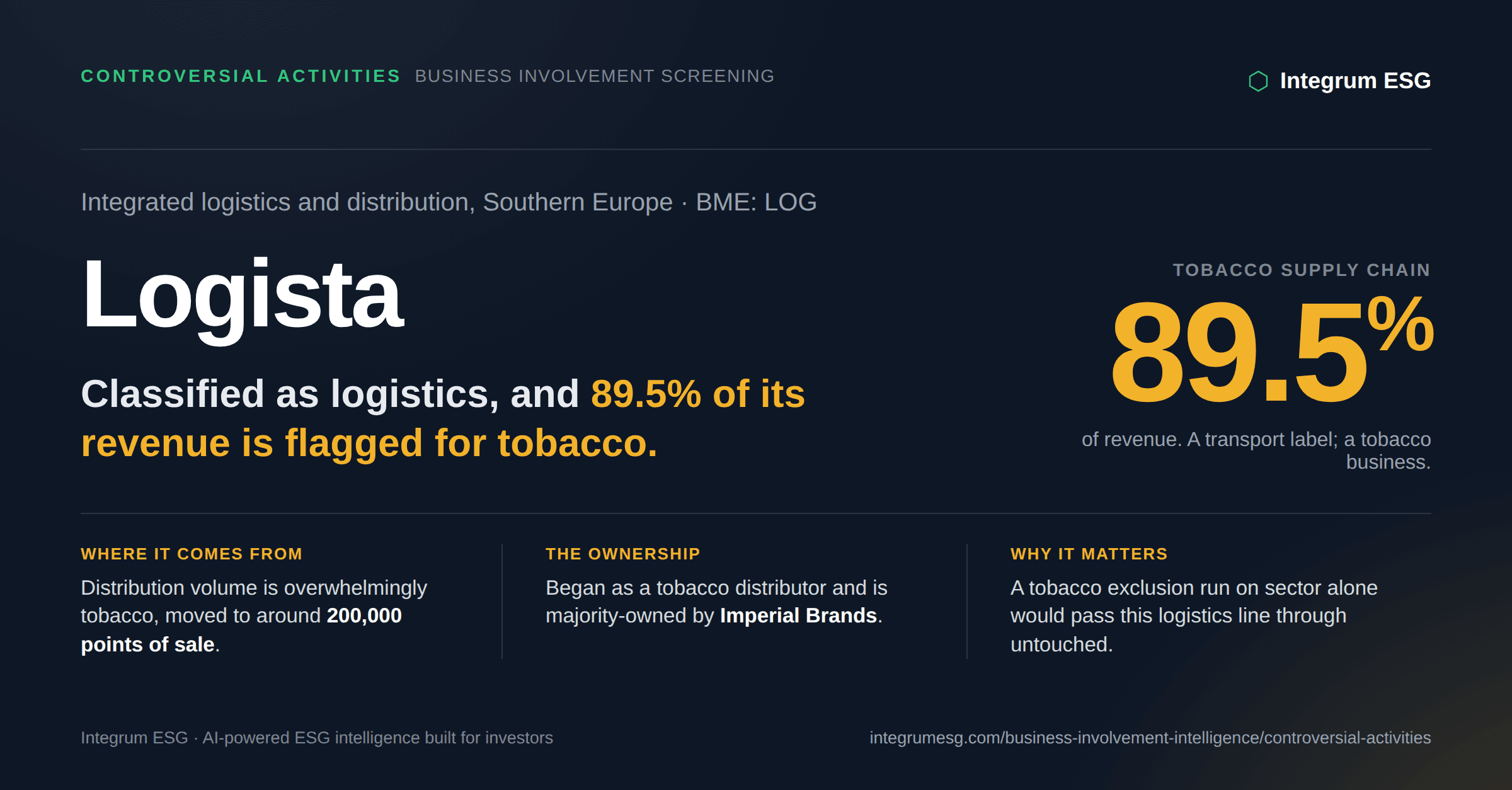
Integrum ESG data attributes 89.5% of its revenue to the tobacco supply chain, because the distribution volume is overwhelmingly tobacco.
Logista began as a tobacco distributor and is majority-owned by Imperial Brands, whose products dominate what it moves.
This is the case where classification and reality diverge most. Nothing in the sector label signals tobacco, yet nearly the entire business is tobacco distribution.
An investor applying a tobacco supply-chain exclusion through a sector filter would pass Logista through untouched. The 89.5% figure, with the activity behind it, is what turns a logistics line item into a screening decision.
Request a full risk report on Logista (BME: LOG) here.
We can screen any portfolio against the full Controversial Activities dataset, showing the exact revenue share, activity category and source for every holding, against your own exclusion thresholds.
For each holding, Business Involvement Intelligence records the activity category, the share of revenue and the source disclosure it is drawn from, so a screen runs on the exposure itself rather than the label. A flag alone does not tell an investor whether 3.1% of a REIT’s rent or 89.5% of a distributor’s revenue falls inside their policy. The category, the number and the activity behind it do.
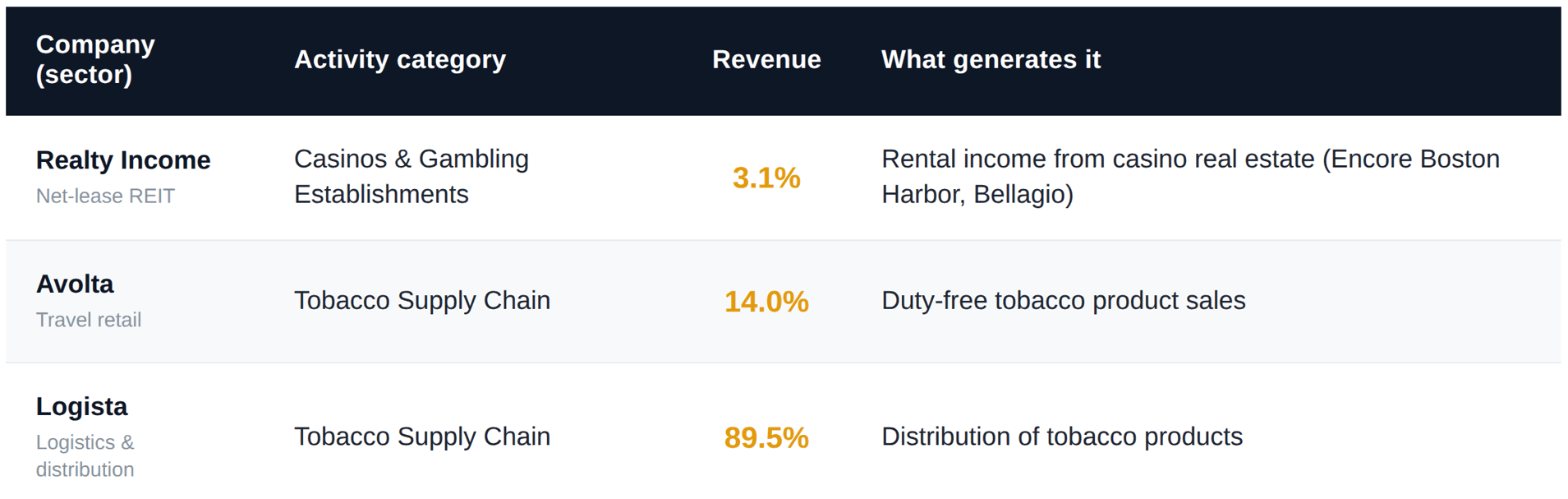
Figures are the share of revenue attributed to each activity in Integrum ESG data. Each is traceable to an original source, with client-specific revenue thresholds applied on top.
A hidden exposure has consequences well beyond disclosure, reaching the regulatory, the contractual and the commercial at once.
Under SFDR, Article 8 and Article 9 funds do not automatically exclude gambling, tobacco or firearms, but where a fund is marketed on an exclusion, a label or a set of binding criteria, a holding that breaches those terms becomes a compliance failure.
The EU fund-naming rules and the FCA labelling and anti-greenwashing regime give regulators powers to require firms to correct or withdraw claims that outrun the portfolio, and to escalate where a firm cannot show its holdings support the label.
That scrutiny is tightening, and managers now carry the burden of evidencing a position rather than asserting it.
Client mandates carry the same weight. An asset owner with a formal exclusion policy, a charity investing to its charitable purpose, or a faith-based mandate that rules out gambling, tobacco or alcohol expects those terms honoured to the letter.
A single undisclosed flag can put a manager in breach of the brief it was hired to run, and a breach the client finds first is far harder to explain than one the manager catches.
The commercial stakes follow directly. A manager able to prove holding by holding that a portfolio meets a client's exclusions can win mandates a competitor relying on sector screening cannot, and can lose an existing client, or a competitive pitch, over an exposure that should have been caught.
Revenue turns on it in the near term and reputation for a good deal longer.
Fund-naming and anti-greenwashing rules exist to close the gap between what a fund claims and what it holds, a question we look at in our analysis of how many funds unknowingly hold SpaceX.
Whether to hold any of these companies is a decision each investor makes for themselves. The harder problem is knowing the exposure is in the portfolio at all, and being able to evidence the decision either way.
For an investment team applying an exclusion policy, or fielding a question from an asset owner about what a labelled fund actually holds, that detail is what supports a confident answer rather than a guess.
Integrum ESG's Controversial Activities dataset covers controversial activity exposure across 40+ categories and the full value chain, built from audited filings and updated quarterly, within 10 days of relevant disclosure, down to the share of revenue and activity behind every flag.


Browse frequently asked questions about the platform.
Can’t find the answer you’re looking for? Please get in touch with our team.