Harish joined the Business Development team at Integrum ESG after having previously overseen BD for the investment network Venture Giants, and also worked within the Customer Experience Program Team at Amazon. He has a BSc in Philosophy, Logic and Scientific Method from the London School of Economics and Political Science.
Space Exploration Technologies (SpaceX - SPCX) saw one of the largest IPOs in history, floating on NASDAQ in June 2026 at a market capitalisation of around 1.77 trillion dollars.
We screened it against a large sample of ETFs, mutual funds and UCITS covered on the Integrum Platform to see how far it had spread. It is already in thousands of fund share classes, including dozens that market themselves on sustainability.
This piece looks at how many funds now hold SpaceX, why conventional ESG screens miss it, and what that means for anyone managing to a sustainable mandate
Short on time? Download the full list of funds holding SpaceX and check your own exposure.
Fund counts collapse share classes to distinct strategies using a name-matching methodology and are current as at July 2026.
SpaceX appears in 5,482 fund share classes across this sample of our coverage.
Most strategies are sold in several currency and accumulation variants, so the clearer measure is distinct funds. On that basis, SpaceX sits in roughly 3,250 distinct funds.
A company at a 1.77 trillion-dollar valuation spreads quickly through the market. It enters benchmarks, feeds into multi-asset portfolios and turns up in funds that investors would never associate with rockets or satellites.
Two cuts of the number matter most for anyone running a sustainability mandate: how much of the exposure is passive, and how much sits inside funds that describe themselves as ESG.
More than 700 of the distinct funds holding SpaceX are index funds or ETFs, over one in five.
Most are passive vehicles. They take on SpaceX automatically as it enters the benchmarks they are built to track, so their investors never chose the stock. A minority are actively managed ETFs, where a manager chose to hold it.
For the passive holders, the question that matters is whether the fund's stewardship engages with the company's governance profile, given they had no say in owning it.
At least 48 of the distinct funds identified carry an explicit ESG, sustainable or responsible label in their name, from broad ESG multi-asset ranges to funds badged around low carbon and responsible investing.
That figure is a conservative floor rather than a total. Most funds run to a sustainability mandate do not signal it in their name, and many funds classified under SFDR as Article 8 or Article 9 carry no sustainability term at all. Fund names alone are an unreliable guide to what a portfolio actually holds.
We identified every ETF, mutual fund and UCITS on the Integrum Platform with exposure to SpaceX. Request the complete list to check your own holdings or screen the competition.
Whether SpaceX shows up as a concern depends on the type of screen an investor runs.
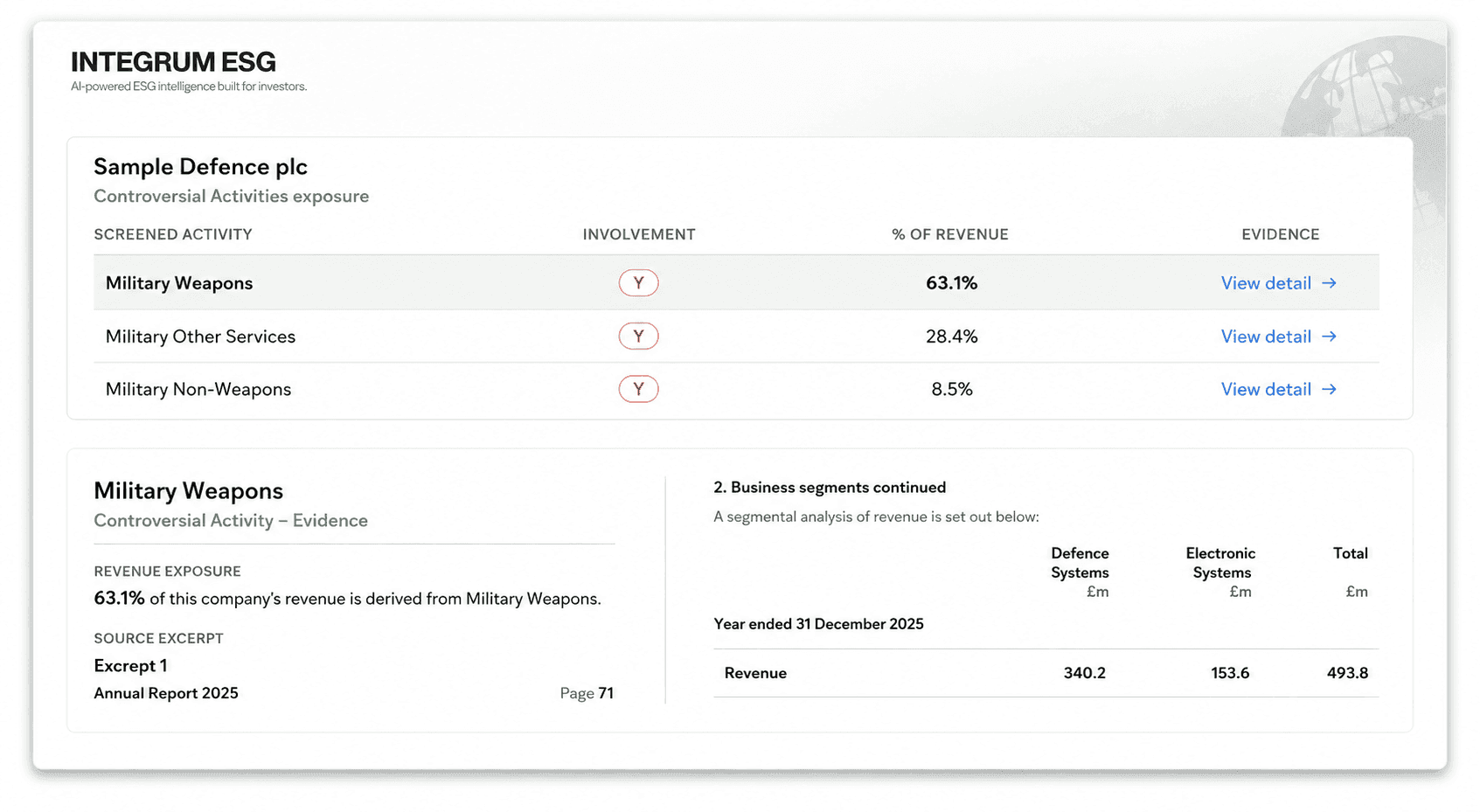
On our Platform, SpaceX flags for two screened activities under Controversial Activities: military non-weapons, and military software and IT services. Both trace back to its launch, mission and connectivity work for government and defence customers. A fund that excludes military and defence involvement broadly would catch it.
Many ESG policies do not screen that broadly. A large share only excludes controversial weapons, meaning cluster munitions, landmines, nuclear, biological and chemical weapons. SpaceX shows no involvement in those, so a weapons-only screen passes it through.
We set out the difference between controversial weapons and wider defence activity in our guide to controversial weapons screening.
Policies that do cover military activity often apply a revenue threshold. Much of SpaceX's income comes from commercial Starlink and launch services, so its military exposure can sit below the level that triggers exclusion.
How activity screening and revenue thresholds work in practice is covered in our breakdown of controversial activities.
So, the granularity of the screen decides the outcome. Separate military non-weapons from controversial weapons and SpaceX shows up. Lump them together and it slips through, held without a flag ever appearing.
There is a third layer. Norms-based screening tests a company against the UN Global Compact and OECD Guidelines, and it is standard for a large share of institutional investors, especially across Europe.
Here the live issue is a lawsuit by tribal, conservation and environmental groups to block the transfer of 715 acres of the Lower Rio Grande Valley National Wildlife Refuge to the company. Minerva Analytics assesses this as a UN Global Compact controversy at high violation level.
Many feeds have not caught it yet, because the listing is only weeks old, controversy data updates on a lag, and the case is a filed lawsuit rather than a proven breach that providers treat differently.
Whether a screen catches the company today comes down to whose data sits behind it and how current it is.
The full assessment of the dual-class structure, board independence, remuneration and the UN Global Compact controversy - delivered by the premier independent proxy voting and ESG research provider Minerva Analytics.
Behind that exposure, three concerns stand out in the company's ESG and governance profile: weak environmental disclosure, concentrated governance and a live controversy.
SpaceX publishes no greenhouse gas emissions policy and sets no targets. It states that it has policies for energy and waste, but reports no figures for either, so its performance cannot be checked against peers.
On disclosure it sits in the bottom quartile of its aerospace and defence peer group for both. That gap is a problem. Investors have no way to size the environmental exposure.
A fund marketed on sustainability cannot show the holding meets its own environmental standards, and the company's exposure to tightening climate regulation and carbon costs sits in the portfolio unmeasured and unpriced.
SpaceX listed with a dual-class structure and a 10:1 voting differential, leaving Elon Musk with about 84 percent of the votes. There is no sunset provision, so that control can continue indefinitely. As a controlled company, SpaceX is exempt from the usual rules on board and committee independence.
Musk holds the combined roles of Chairman, Chief Executive and Chief Technical Officer, and just one of the eight board members is a woman, with no female representation among the non-executive directors.
The package centres on one billion Class B restricted shares, worth around 135 billion dollars. Each tranche vests against a market-capitalisation milestone and the establishment of a permanent human colony on Mars of at least one million people.
A separate award inherited from the xAI merger was switched into higher-voting Class B shares. Musk can vote the unvested shares, which tightens his grip further.
For an outside investor, this is the crux: with control this concentrated and no sunset, minority shareholders have almost no way to challenge strategy, remove directors or hold management to account.
If the business stumbles, or its dependence on one person becomes a liability, they carry the downside with little recourse.
Beyond the refuge lawsuit, more than 70 Texas residents have sued over property damage they link to Starship test flights. Both cases carry legal, financial and licence-to-operate risk that a company profile alone would not reveal.
Its tax contribution last year, at 718 million dollars, ran well ahead of its aerospace peers relative to revenue, and lifts its wider societal-impact reading. For a sustainability mandate, the disclosure and governance gaps still carry the most weight.
The full breakdown of SpaceX's environmental, social and governance performance, with peer benchmarking and the underlying evidence for every metric - powered by Integrum Assist ⬡˚.
Whether to own SpaceX is a decision each investor makes for themselves. The harder problem is knowing whether the company is in a portfolio at all.
For a fund that carries a sustainability label, holding a company like this is a mandate-consistency risk before it is anything else. As anti-greenwashing rules and fund-naming standards tighten, the gap between what a fund claims and what it holds has become a regulatory and reputational exposure, not just a presentational one.
A risk the investor cannot see is one they cannot price, vote on, engage with or exit. Better data is what turns unknown exposure into a decision. Seeing the exposure, and judging it, takes holdings-level visibility set against company-level ESG and governance analysis.
Integrum ESG's Funds Intelligence solution maps fund exposure across more than 60,000 companies and 250,000 funds, refreshed within 10 days of disclosure, down to the individual underlying holdings.
For a fund manager fielding questions from an asset owner, or an owner reviewing what a labelled sustainable fund actually holds, that visibility is the difference between a confident answer and a guess.


Browse frequently asked questions about the platform.
Can’t find the answer you’re looking for? Please get in touch with our team.