
Abbie joined Integrum ESG as Head of Business Development in 2025. Prior to this, Abbie headed up the Sales Team at SeedLegals, consistently driving double digit YoY growth. Having worked in a variety of Sales roles in multiple industries (Digital Marketing, Law, Fashion, LegalTech), Abbie has a keen awareness of understanding exactly what a prospective client needs, in order to translate this into a successful product and commercial strategy. Abbie has a M.A. in Modern Languages from Oxford University.
SDG revenue alignment measures the share of a company's revenue derived from products and services that contribute to the United Nations Sustainable Development Goals (SDGs), the 2030 Agenda for global development adopted by all 193 UN member states in 2015.
The critical word is revenue. A pharmaceutical company that manufactures essential medicines for developing markets is aligned to Goal 3 (Good Health and Well-being) whether or not it names the SDG in its annual disclosures. A company that references every one of the 17 SDGs on its corporate website is not aligned unless its products and services actually contribute.
This distinction is what makes revenue alignment usable for institutional investors. It converts a normative framework into a measurable one.
The framework used to structure SDG alignment across the investment industry is the Sustainable Development Investments (SDI) taxonomy, published by the SDI Asset Owner Platform, a consortium of some of the world's largest pension funds, including APG, PGGM, AustralianSuper and British Columbia Investment Management Corporation.
This article covers which of the SDGs are treated as investable, why alignment is best measured at target level rather than goal level, the gaps between corporate SDG claims and revenue actually derived from aligned activities, and how Integrum ESG’s SDG Revenue Alignment dataset helps investors identify and assess those gaps.
The UN's 2030 Agenda sets out 17 SDGs, but at the corporate level only 15 are considered investable.
Goals 16 (Peace, Justice and Strong Institutions) and 17 (Partnerships for the Goals) sit outside the scope of corporate operations. Goal 16 relates to the rule of law, the reduction of violence, effective institutions and access to justice. Goal 17 concerns international cooperation, multilateral finance and cross-border partnerships. Neither is meaningfully deliverable through corporate products or services, and the SDI Asset Owner Platform taxonomy therefore treats them as outside the scope of revenue alignment.
That leaves 15 investable goals, with 138 underlying investable targets between them. A further set of targets, the means-of-implementation targets lettered .a, .b and .c, are directed at sovereign authorities and policymakers rather than at business. These are also excluded from corporate revenue alignment.
The result is a working framework of 15 goals and 138 targets that can be applied against companies rather than against countries or governments.
Alignment measured at the level of the goal is too coarse to inform investment decisions.
For example, Goal 6 (Clean Water and Sanitation) contains eight underlying targets, six of which are investable at the corporate level. These targets cover safely managed drinking water (6.1), sanitation and hygiene (6.2), water quality and pollution reduction (6.3), water-use efficiency (6.4), integrated water resources management (6.5) and the protection of water-related ecosystems (6.6).
A company distributing bottled water to underserved communities in South Asia is aligned to Target 6.1. A company selling industrial water recycling systems to manufacturers is aligned to Target 6.4.
Both companies contribute to Goal 6 in aggregate, but the specific target each contributes to is materially different and, for an investor building a thematic water fund, so is the mandate fit.
Assessing alignment at target level is what makes the framework operational. A fund mandate written against a specific target can be filled with companies that genuinely serve that target.
A mandate written against a goal as a whole risks pulling in companies whose contribution is nominal or tangential, and diluting the fund's stated purpose.
SDG revenue alignment data supports several distinct use cases:
1. SDG-aligned mandate construction and monitoring
Building portfolios against specific goals or targets, applying revenue thresholds at either level and monitoring alignment over time.
2. Impact and thematic fund positioning
Identifying companies generating revenue from measured contribution rather than from SDG-referenced marketing. Building water funds against Target 6.1 rather than Goal 6. Building health funds against essential medicines targets rather than Goal 3 as a whole.
3. Regulatory and client disclosure
Reporting under SFDR Article 9 sustainable investment requirements, and providing target-level alignment data alongside Controversial Activities and EU Taxonomy data drawn from the same underlying revenue dataset.
4. Engagement and stewardship
Identifying companies whose product mix could align to specific targets with modest strategic change, and using target-level data to inform engagement rather than a single aggregate SDG score.
5. Manager selection and due diligence
Asset owners and consultants comparing fund managers on measured alignment across a stated set of targets rather than on narrative claims about SDG intent.
Three forces have moved SDG revenue alignment from a reporting exercise into a core investment capability.
Regulatory disclosure requirements.
Under SFDR Article 9, funds classified as making sustainable investments must be able to demonstrate that their investments contribute to environmental or social objectives without significantly harming any other objective.
The SDG framework, with its measurable target-level indicators, has become the most widely adopted proxy for this contribution requirement. The evolving SFDR 2.0 framework is expected to tighten these requirements further, with proposed sustainability categories requiring evidenced contribution alongside the existing do-no-significant-harm criteria.
Asset owner mandate demand.
Pension funds, foundations and endowments increasingly write SDG-aligned mandates that specify goals or targets a portfolio must contribute to, thresholds that must be met, or reporting requirements at the target level.
Consultants advising these asset owners are being asked to compare managers on measurable alignment rather than on narrative claims.
Impact and thematic fund construction.
Asset managers building impact funds, thematic funds and Article 9 vehicles need to identify companies generating revenue from aligned activities rather than companies making SDG claims.
The universe of the first is materially different from the universe of the second, and the difference matters for both mandate compliance and downstream LP scrutiny.
There are a few common problems which have impacted how investment teams have historically worked with this data including:
Self-reported claims rather than measured activity.
Much of the SDG data on the market draws on companies' own SDG disclosures, which are voluntary, marketing-flavoured and unaudited. A company that references SDGs 3, 5, 8, 12 and 13 in its sustainability report may be doing genuine work against those goals, or it may be repurposing existing practice under an SDG banner.
Distinguishing the two requires assessment against actual revenue-generating activity, not against corporate narrative.
Goal-level aggregation.
MSCI's SDG Alignment product, Sustainalytics' SDG Solutions and ISS's SDG Solutions Assessment each provide alignment data, but most surface a single alignment percentage or classification at the goal level.
This is useful as a headline metric but insufficient for mandate construction, target-level disclosure or the kind of fund positioning that Article 9 buyers and asset owner consultants now expect.
Limited methodological transparency.
As with negative screening data, the workings behind an alignment percentage are rarely shown back to source. A company reported as 40% aligned to Goal 3 rests on a chain of decisions about which product lines qualify, which targets they serve and how revenue has been allocated.
Where the methodology is not disclosed and the source is not cited, the number is difficult to defend to a client, trustee or regulator.
Integrum's SDG Revenue Alignment dataset, powered by Syntax's Affinity™ data, is built to address the three gaps directly.
Alignment is assessed against the individual investable targets inside each of the 15 investable goals, using the SDI Asset Owner Platform taxonomy. A fund mandate can be written against Target 6.1 or Target 3.b rather than against the goal as a whole.
Alignment is derived from what a company actually sells. Corporate SDG claims, pledges and narrative disclosures are not the input. The starting point is the revenue mix disclosed in audited public filings.
Alignment is calculated at the product-line level, not the company level. A diversified business is credited only on the portion of its revenue that falls within an aligned activity, so the alignment figure reflects the actual scale of contribution rather than a company-wide average.
Every classification is built from 10-Ks, 20-Fs, 40-Fs, annual reports and sustainability reports. Not from third-party databases, not from estimates, not from self-reported scores.
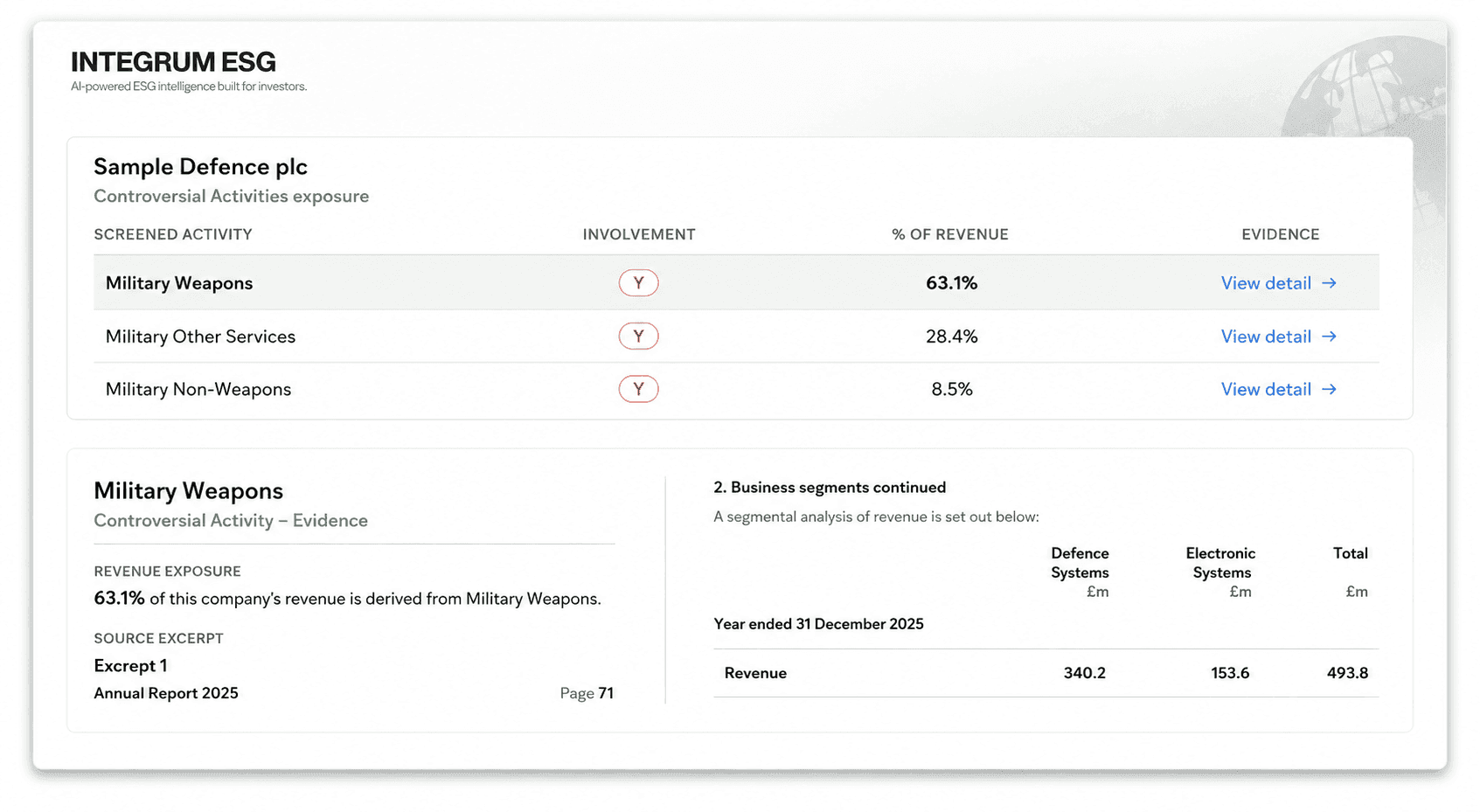
Every alignment percentage and every flag links directly to the relevant excerpt from the company's source filing, with page references. Investment teams can open the underlying disclosure, read the verbatim text and defend the alignment to a committee, client or regulator.

SDG Revenue Alignment sits within Business Involvement Intelligence, alongside Controversial Activities, EU Taxonomy eligibility and standard industry classifications. A company classified once flows through every framework an investor reports against.
SDG Revenue Alignment data assists with thematic and impact fund construction, regulatory disclosures and engagement.
A few useful questions if you are scoping a change:
The honest way to find out is a side-by-side comparison. Send us a fund or a mandate and we will show you target-level alignment on every holding, cited back to source.


Browse frequently asked questions about the platform.
Can’t find the answer you’re looking for? Please get in touch with our team.