
Shai began his career on the buyside at what is now JP Morgan AM, before moving to the sellside where he worked in several research roles. He was Head of Research at Macquarie Group for 10 years before founding Integrum ESG in 2018. Shai has an M.A. from Cambridge University.
Anthropic's prospectus sets out $900.9bn of commitments to compute and infrastructure. It gives no estimate of the electricity needed to run that capacity, even though it names a shortage of power as a risk to its ability to grow.
Anthropic launched its IPO roadshow on 10 November at $70 to $78 a share. It is expected to price on 18 November and begin trading on Nasdaq under the ticker ANT the following day, according to CNBC. It comes to market after a sell-off in AI stocks earlier this month that raised questions about how far local and political opposition could slow data centre construction.
Anthropic, PBC is now covered on the Integrum ESG Platform, with governance analysis from Minerva Analytics. Integrum ESG's new report, Anthropic: Risks Named, Numbers Missing, sets out what the prospectus quantifies, what it leaves out and what that means for investors.
Prospectus figures are from Anthropic's Form S-1/A, Amendment No. 2, filed 10 November 2026. Peer data is from the Integrum ESG Platform as at 11 November 2026.
Short on time? Download the full report on Anthropic.
$900.9bn of compute and infrastructure commitments are set out in Anthropic's prospectus, $451.6bn of them expected before the end of 2030.
Compute and infrastructure expenses rose to 58% of revenue in the third quarter of 2026, from 48% in the second.
The prospectus gives no figure for the electricity that capacity will use or for its power capacity by location, though it names power supply and local moratoriums on data centres as risks.
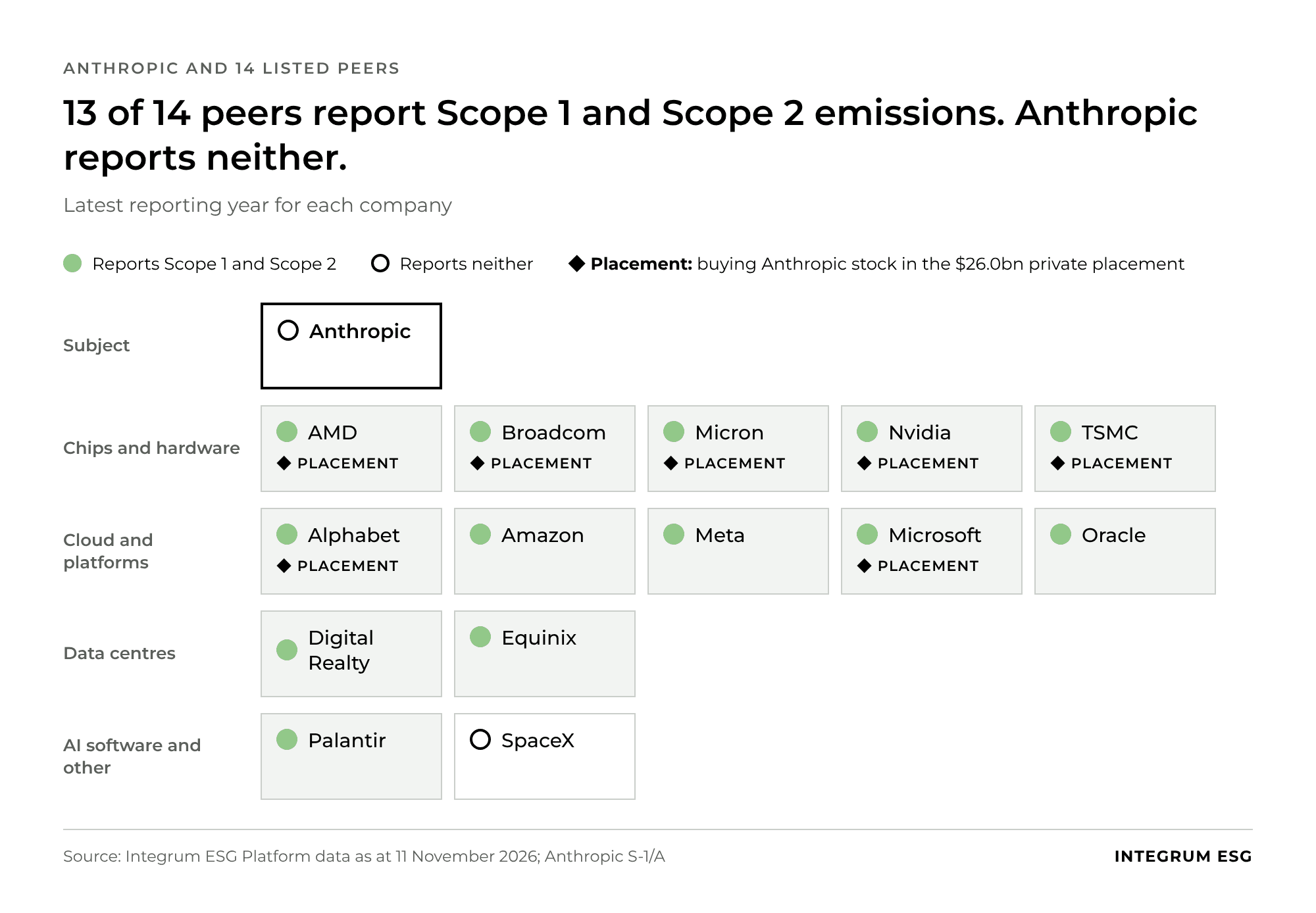
13 of 14 listed peers in the AI supply chain report Scope 1 and Scope 2 emissions, including the seven companies buying $26.0bn of Anthropic stock alongside the IPO. Anthropic reports neither.
Anthropic quantifies its compute commitments in detail. Including agreements signed after 30 September, it has committed to spend approximately $900.9bn under purchase and lease agreements, almost all of it on compute and infrastructure, according to its latest filing. About $451.6bn of that is expected before the end of 2030, and the filing sets the total out by year and by counterparty.
The cost already shows in its results. Compute and infrastructure expenses rose to 58% of revenue in the third quarter of 2026, from 48% in the second, including $5.0bn of compute bought on short-term commitments.
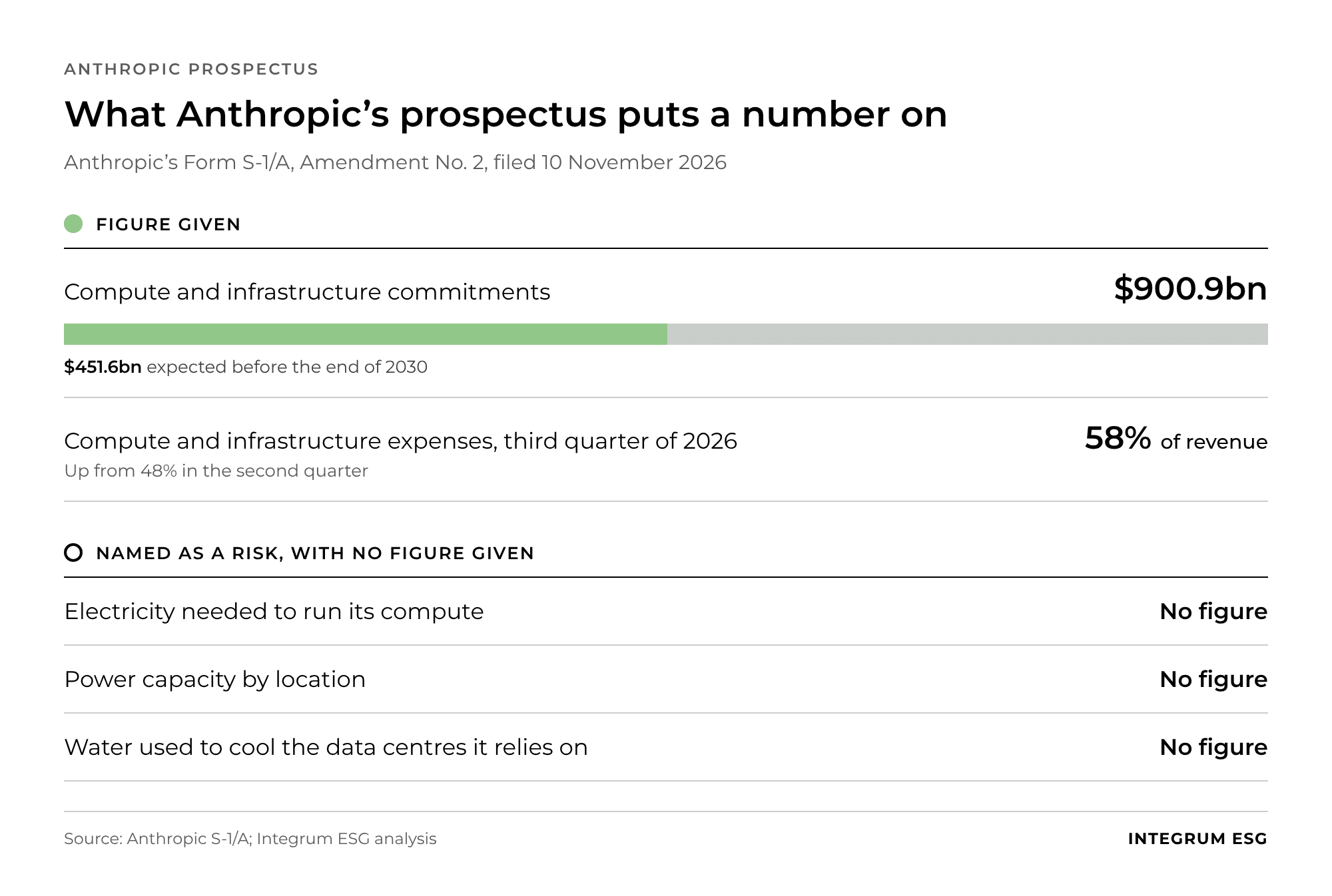
The prospectus names a failure to secure enough electrical power as a risk to Anthropic's ability to scale, and cites state and local moratoriums on new data centre construction. It gives no figure for the electricity its compute uses, the power capacity it needs in each location or the water used to cool the data centres it relies on.
Its prospectus also records Anthropic's public commitment to cover the cost of electricity price increases that its data centres cause for consumers. Without a figure for how much electricity those data centres use, investors cannot size that commitment.
The report sets out what these gaps mean for margins as $451.6bn of commitments fall due before the end of 2030. Download the report.
Integrum ESG compared Anthropic with 14 listed companies across the AI supply chain, from chipmakers and cloud providers to data centre operators. Thirteen of them report Scope 1 and Scope 2 emissions, and SpaceX is the only one that reports neither. Scope 2 emissions are calculated from the electricity a company buys, the figure Anthropic's prospectus leaves out.
Seven of those companies will also become Anthropic shareholders. Alphabet's Google, Nvidia, Microsoft, AMD, Broadcom, Micron and TSMC have agreed to buy $26.0bn of non-voting stock at the IPO price, and all seven report the Scope 1 and Scope 2 figures that Anthropic omits.
Anthropic: Risks Named, Numbers Missing extends the peer comparison across eight areas of disclosure, from energy and water use to data security, board and pay. It also sets out:
who controls Anthropic once it lists, with governance analysis from Minerva Analytics: the founders' single Class F share carries 50.1% of the general vote, and the Long-Term Benefit Trust elects four of the seven directors;
how asset managers, asset owners, wealth managers, hedge funds and private markets investors are each exposed;
how Anthropic scores on the Integrum ESG Platform against the Software & IT Services sub-sector; and
the questions investors should put to Anthropic before and after it lists.


Browse frequently asked questions about the platform.
Can’t find the answer you’re looking for? Please get in touch with our team.