
Shauna joined the BD team at Integrum ESG in 2021, having previously worked in similar roles within Fintech companies. She holds a BA in English and New Media Studies from the University of Limerick, Ireland.
Asset managers across Europe have loosened their defence exclusions this year, and regulators have confirmed that sustainable funds may hold the sector.
Integrum ESG analysed the holdings of more than 6,700 funds that report themselves as Article 8 or Article 9 under the EU's Sustainable Finance Disclosure Regulation (SFDR) to see how that shift shows up in portfolios.
This article sets out how many of those funds hold defence companies, how large the positions are, where the exposure concentrates and what fund selectors should check.
Fund holdings are looked through to company level using Integrum ESG fund and Controversial Activities data, as at 4 November 2026.
Short on time? See the defence exposure across your own fund list.
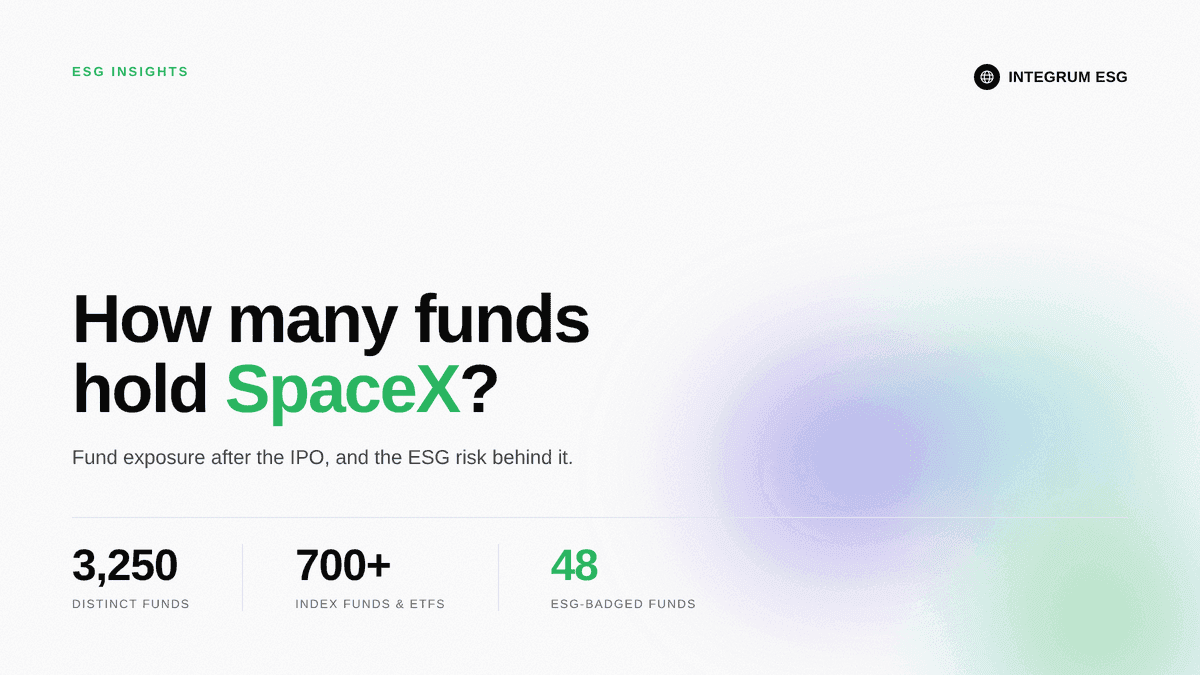
57% of Article 8 and 9 funds hold at least one company with military revenue.
40% hold a company that earns more than 10% of its revenue from military weapons, the threshold JPMorgan Asset Management removed from 124 of its funds in January.
Positions are small. Military weapons revenue accounts for 0.20% of the average fund, and only 2% of funds put more than 5% of their holdings into companies above the 10% line.
Multi-asset and eurozone equity funds carry the most exposure. 70% of euro multi-asset funds and 64% of eurozone equity funds hold a company above the 10% line.
SFDR 2.0 leaves conventional weapons to managers. The proposals keep controversial weapons as a minimum exclusion across all three new fund categories.
For most of the past decade, European sustainable funds excluded weapons makers as routinely as tobacco producers. That has shifted as European defence budgets have risen.
In January, JPMorgan Asset Management removed a 10% revenue threshold on conventional weapons from 95 Luxembourg and 29 Irish funds. Its shareholder notices cited "evolving client expectations relating to defence preparedness", according to Funds Europe.
Franklin Templeton, Columbia Threadneedle, DWS and Allianz Global Investors have relaxed similar exclusions, according to Defence Deals.
The European Commission has made clear that managers may do so. Its notice on the sustainable finance framework and the defence sector describes the framework as "neutral with regard to the defence sector". It adds that generalised exclusions based on turnover "would not be consistent with a case-by-case logic".
The notice singles out only prohibited weapons: anti-personnel mines, cluster munitions, biological and chemical weapons.
SFDR 2.0 looks set to keep that approach. The Commission's proposal applies controversial weapons, tobacco, UN Global Compact and OECD Guidelines exclusions to all three new fund categories. Conventional weapons are not among them, according to A&O Shearman.
Trilogue negotiations between the Commission, Council and Parliament were expected to open on 22 October, with a deal targeted before the end of the year.
The decision on conventional weapons therefore rests with each manager, and a fund's SFDR category does not show which way that decision went. Integrum ESG set out to measure what Article 8 and 9 funds already hold.
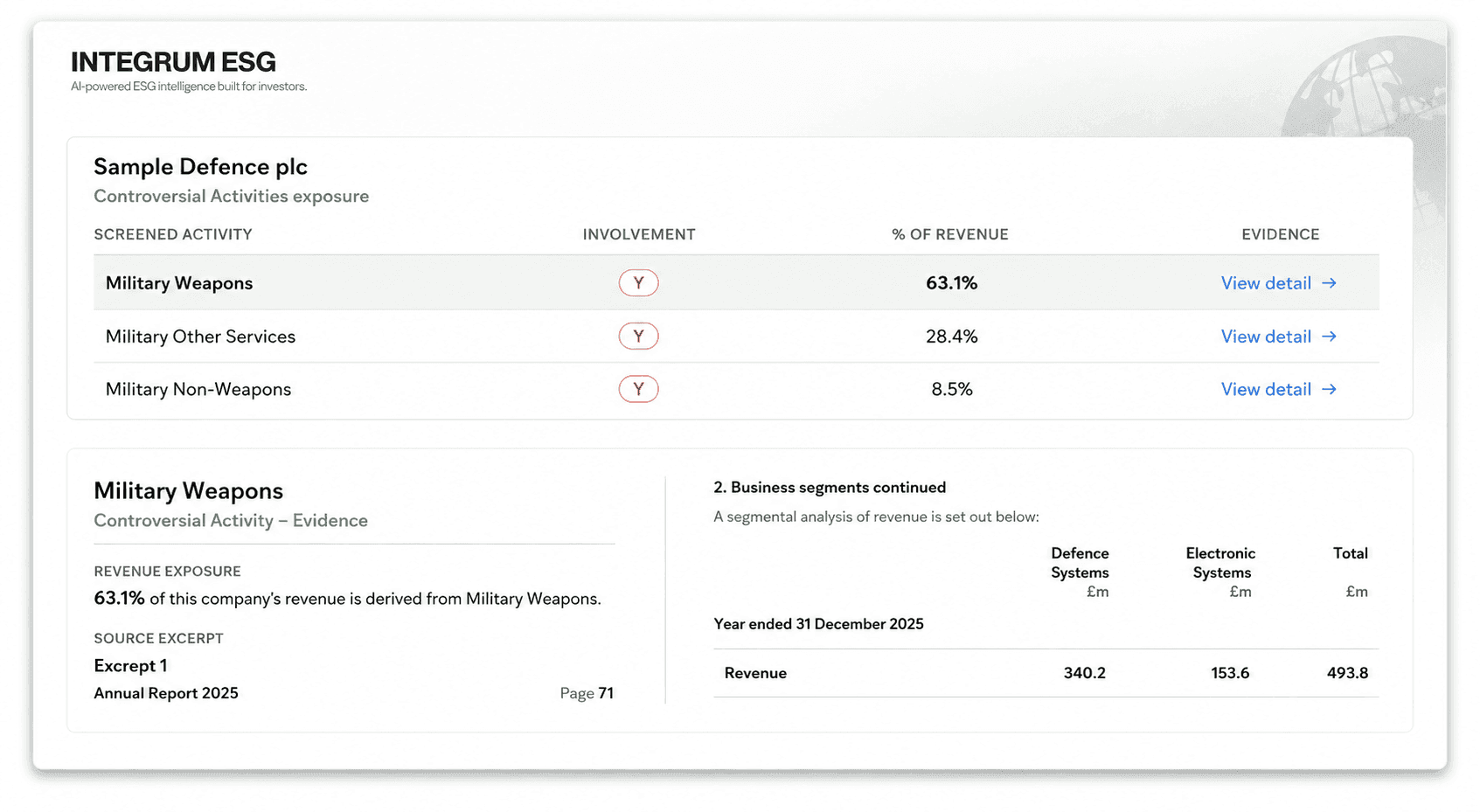
Integrum ESG looked through each fund's holdings to company level and measured each company's revenue from military weapons and from military non-weapons products and services.
Across the 6,740 funds, 57% hold at least one company with military revenue, and 40% hold a company that earns more than 10% of its revenue from military weapons.
| Share of Article 8 and 9 funds holding at least one company with | Share of funds |
|---|---|
| Any military revenue (weapons or non-weapons) | 57% |
| Any revenue from military weapons | 42% |
| More than 5% of revenue from military weapons | 41% |
| More than 10% of revenue from military weapons | 40% |
Source: Integrum ESG. 6,740 self-reported Article 8 and 9 funds, data as at 4 November 2026.
The last three rows sit close together because most funds with military weapons exposure hold at least one company above the 10% line: 96% of them do.
Lowering a threshold from 10% to 5% would therefore exclude few additional funds. Whether a manager applies a conventional weapons exclusion has a much larger effect than the level at which it is set.
Weighted by holdings, the exposure is small. Military weapons revenue accounts for 0.20% of the average fund, calculated as each holding's weight multiplied by its share of revenue from military weapons.
Concentrated positions are rare. 132 funds (2.0%) put more than 5% of their covered holdings into companies above the 10% line.
Where funds do hold military-involved companies, those companies make up 2.1% of covered holdings on average.
Breadth and region account for much of the variation. Euro multi-asset funds hold 762 companies at the median, so a defence name is likely to appear somewhere in the portfolio.
In eurozone equity, Thales, Airbus, Leonardo and Rheinmetall are among the largest listed defence companies in the region, so a fund without a conventional weapons exclusion is likely to hold at least one of them.

Euro multi-asset combines the four global mixed asset EUR segments.
US equity funds follow. RTX, Boeing, Honeywell International and Parker-Hannifin all derive more than 10% of their revenue from military weapons and all four are S&P 500 constituents. Of the segments shown, bond funds carry the least exposure.
Our fund list sets out a selection of Article 8 and Article 9 funds with high military weapons revenue exposure, with the holdings behind each figure.
Pure-play defence groups fail any conventional weapons screen. Rheinmetall derives 99.3% of its revenue from military weapons and Leonardo 85.6%.
The difficult cases are diversified aerospace and industrial groups that sit close to a common threshold.
| Company | Revenue from military weapons | Fails a 10% screen | Fails a 15% screen | Fails a 20% screen |
|---|---|---|---|---|
| Thales | 31.0% | Yes | Yes | Yes |
| Honeywell International | 19.3% | Yes | Yes | No |
| Airbus | 17.3% | Yes | Yes | No |
| Rolls-Royce Holdings | 12.8% | Yes | No | No |
| Parker-Hannifin | 10.3% | Yes | No | No |
Source: Integrum ESG Controversial Activities data, latest reported year.
Parker-Hannifin, at 10.3%, would pass a 10% screen after only a small shift in its revenue mix. A fund that screens at 20% can hold four of these five companies and still describe itself as excluding weapons manufacturers.
Disclosure is a further complication. Safran is among the defence companies most widely held by Article 8 and 9 funds, but it does not disclose enough to attribute a share of its revenue to military weapons. A policy that acts only on disclosed percentages will pass it.
For the activities investors screen most often, and how revenue exposure to each is measured, see our breakdown of controversial activities.
A fund's SFDR category is not a reliable guide to its defence exposure. Where clients expect weapons to be excluded, that needs confirming at holdings level.
Four checks are worth making:
The policy: whether the manager applies a conventional weapons exclusion, at what revenue threshold and whether that changed in 2026.
The holdings: company-level exposure, including inside multi-asset funds and funds of funds, where defence names often arrive through index components.
The edge cases: holdings within a few points of the threshold, which a single change in revenue mix can move across it.
Undisclosed involvement: how the policy treats companies with confirmed military involvement but no disclosed revenue share.
Rising defence budgets, looser manager policies and a sector-neutral regulatory framework are unlikely to reverse while SFDR 2.0 is finalised. Defence companies are likely to remain in a large share of Article 8 and 9 funds.
Investors who select funds for clients need to confirm that each fund's holdings match what those clients have been told about it.
Integrum ESG's Funds Intelligence looks through 250,000+ mutual funds, UCITS and ETFs to company level, with holdings refreshed monthly. Its Controversial Activities data measures each company's revenue exposure at product-line level, based on company filings.
Results feed screening, ESG Risk Reports and One Click Compliance reports for SFDR and TCFD.
Universe: funds covered by Integrum ESG whose managers report them as SFDR Article 8 or Article 9. Integrum's own SFDR classification of each fund is not used. Because many funds moved from Article 9 to Article 8 during 2022 and 2023, the two categories are treated as one group.
Share classes: share classes with identical holdings are counted once. Funds with fewer than 20 covered holdings are excluded, since most of these disclose only their largest positions. This leaves 6,740 funds.
Holdings: latest available holdings, looked through to company level, with weights expressed as a share of covered holdings.
Defence exposure: company revenue from Military Weapons and Military Non-Weapons in Integrum ESG's Controversial Activities dataset. "Military revenue" means either category.
Thresholds: the 5%, 10%, 15% and 20% tests apply to a company's revenue from military weapons, the basis used by the revenue threshold policies described above.
Undisclosed revenue: companies with confirmed military weapons involvement but no disclosed revenue share count towards "any military revenue" only. Treating them as above every threshold raises the share of funds holding a company above 10% to 42%.
Date: data as at 4 November 2026.
Our Controversial Activities methodology sets out how each company's revenue is attributed to each controversial activity, from military weapons to fossil fuels.
Fund selectors use Integrum ESG to answer questions a fund's SFDR category does not:
Which of my funds hold companies above my weapons threshold?
Which holdings sit within a few points of that threshold?
Which companies have confirmed military involvement but no disclosed revenue share?
See each fund's holdings looked through to company level, with the revenue exposure behind every figure.


Browse frequently asked questions about the platform.
Can’t find the answer you’re looking for? Please get in touch with our team.