
Harish joined the Business Development team at Integrum ESG after having previously overseen BD for the investment network Venture Giants, and also worked within the Customer Experience Program Team at Amazon. He has a BSc in Philosophy, Logic and Scientific Method from the London School of Economics and Political Science.
Grand Theft Auto VI launches on 19 November, and Take-Two Interactive, which owns its publisher Rockstar Games, is counting on it. Take-Two expects net bookings of $8.0bn to $8.2bn in the year to March 2027, around a fifth more than last year, and says pre-orders have run far ahead of its expectations.
Investors who want a share of that can buy Take-Two or a video game fund that holds it. Either way, they take on risks that are hard to see from Take-Two's reporting or from the name of the fund.
Take-Two now makes most of its money from what players spend inside its games, yet it does not say how many data breaches it has. The specialist video game funds are far more concentrated than the broad market and heavily weighted to Japan, and both VanEck funds hold a slot machine maker among their ten largest positions.
This article uses company, controversial activities and fund data from the Integrum ESG Platform to look at Take-Two's breach disclosure and board oversight, and at what five video game exchange-traded funds (ETFs) hold.
Company figures are the latest each company has reported. Fund figures use each fund's latest monthly holdings on the Integrum ESG Platform, 18 November 2026.
Hold Take-Two or a video game ETF? See what sits underneath it on the Integrum ESG Platform.
Take-Two expects net bookings of $8.0bn to $8.2bn in the year to March 2027, supported by the GTA VI launch. Recurrent consumer spending, the money players spend inside its games, made up 81% of net bookings in the three months to September.
Rockstar Games has had three incidents since 2022 in which company data or unreleased footage reached outsiders, but Take-Two publishes no breach count. None of the seven games companies worth $10bn or more on the Integrum ESG Platform publishes privacy or data breach figures, against around a third of software and IT services companies of the same size.
Take-Two's independent directors have served an average of 11.4 years, against 7.9 years across the S&P 500. The board set up a Technology Risk Committee in October 2025.
The five video game ETFs hold 52% to 74% of their assets in their ten largest positions and 20% to 37% in Japanese companies. All five score below MSCI World on the Integrum ESG Platform.
Both VanEck funds have more than 4% of their look-through revenue attributed to gambling, mostly through slot machine maker Aristocrat Leisure. The UCITS fund's exclusions do not cover gambling.
Take-Two Interactive
Rockstar Games, the label behind Grand Theft Auto, is wholly owned by Take-Two. Its last instalment, Grand Theft Auto V, has sold nearly 235 million units since its release in 2013, according to Take-Two's November 2026 investor presentation.
Take-Two's second-quarter results forecast net bookings of $3.35bn to $3.5bn for the three months to December, the quarter of the launch. That is nearly double the $1.76bn of a year earlier.
On its November earnings call, management said pre-orders were far in excess of its initial expectations. Take-Two has not given a figure, but market data firm Sensor Tower estimated 15.88 million digital pre-orders on PlayStation and Xbox by 17 November, worth about $1.54bn.
Take-Two also earns from what players spend once they are playing, which it reports as recurrent consumer spending: virtual currency, add-on content, in-game purchases and in-game advertising.
That spending is now most of the business. The same results show it made up 81% of net bookings in the three months to September. Even with GTA VI launching this financial year, Take-Two told investors in August that it expected the measure to make up about 64% of net bookings in the year to March 2027.
Net bookings is the measure Take-Two uses to track sales: the net value of games and services sold in a period, digitally or to retailers, including licensing fees, merchandise and in-game advertising. It can differ from reported revenue because accounting rules spread some sales over later periods.
All of that spending runs through player accounts, so how well Take-Two protects them matters to its shareholders as much as to its players.
Rockstar has already had three incidents since 2022 in which company data or unreleased footage reached outsiders.
| Date | What happened | Company response |
|---|---|---|
| Sep 2022 | An intruder downloaded confidential information, including early GTA VI footage, which then circulated online | Rockstar confirmed a "network intrusion" |
| Apr 2026 | Hacking group ShinyHunters claimed to have taken 78.6 million records from Rockstar's Snowflake account through analytics provider Anodot. Reuters could not verify the claim | Rockstar said a limited amount of non-material company information was accessed, with no impact on players |
| Aug 2026 | GTA VI gameplay footage was posted online from 18 August under the name CyberLeek | Take-Two sought court subpoenas naming Microsoft, Discord, Google and X |
Sources: company statements, Reuters and court filings.
None of this appears to have dented demand for the game, judging by the pre-order estimates.
Shareholders cannot tell how often incidents like these happen across Take-Two or how many users they affect, because Take-Two does not publish either figure.
Not as a number. Take-Two reports against the SASB standard for software and IT services, which asks companies to count their data breaches each year. Take-Two's answer is that any material breach would be disclosed in its SEC filings.
Metric TC-SI-230a.1 in the Sustainability Accounting Standards Board's software and IT services standard asks each company for three figures a year: the number of data breaches, the share involving personal data and the number of users affected.
That leaves Take-Two to decide which breaches count, and April shows what this means for shareholders. A hacking group claimed to have taken 78.6 million records and Rockstar said the information accessed was non-material. Take-Two's reporting gives investors no figure to check either account against.
CD Projekt, the Polish developer behind The Witcher and Cyberpunk 2077, takes a different approach. It answers the same SASB question directly, including in 2024, when it had a case involving customers' personal data to report.
| SASB TC-SI-230a.1 | Take-Two Interactive | CD Projekt |
|---|---|---|
| Latest answer | "Any material data breach incidents would be disclosed in the Company's SEC filings" | Not aware of any unauthorised access to customer data during 2025 |
| Previous answer | The same wording | One case involving customers' personal data in 2024 |
Sources: Take-Two's 2026 Impact Report, covering April 2025 to March 2026, and 2025 Impact Report; CD Projekt's 2025 SASB disclosure and 2024 SASB disclosure.
Take-Two is typical of the largest games companies. Integrum ESG's company data records, metric by metric, whether each company publishes a figure.
Games publishers sit in the same Software & IT Services sub-sector as Microsoft and Infosys, so the natural comparison is with software companies of a similar size.
| Share of companies worth $10bn or more that publish a figure | Games companies (7) | Other software and IT services companies (97) |
|---|---|---|
| Customer privacy breaches | 0% | 37% |
| Data security breaches | 0% | 30% |
| Incidents of anti-competitive behaviour | 14% | 30% |
Source: Integrum ESG Platform, November 2026. Games companies: NetEase, Take-Two, Roblox, Konami, Nexon, Capcom and Electronic Arts (now delisted). Electronic Arts is the only one of the seven to publish a competition figure.
None of the seven games companies publishes privacy or data breach figures, while around a third of the software companies do. The gap holds even against much smaller businesses: among software companies worth less than $10bn, about one in seven publishes these figures.
Breaches at games companies still come to light. Capcom, one of the seven, published a notice in October after unauthorised access to its CAPCOM ID service, counting 11,774,247 affected records. Integrum ESG's real-time alerts pick up notices like this at a holding as they are published.
A one-off notice still leaves investors without a yearly count against a common standard, which is what lets them compare one year with the next and one company with another.
With no breach count to go on, shareholders are left to judge how the board oversees the risk.
Take-Two's board has ten directors, nine of them independent under Nasdaq rules, according to its 2026 proxy statement. Its core has been in place since March 2007, when Strauss Zelnick, now executive chairman and chief executive, joined at the same time as three of the current independent directors.
That shows in the tenure figures. Measured on the dates in the proxy, the nine independent directors had served an average of 11.4 years when it was filed, against 7.9 years across the S&P 500, according to Spencer Stuart's 2026 Board Index. Five of the nine have served more than nine years, the point at which the UK Corporate Governance Code says a director's independence may be impaired.
Long service brings continuity, and this board has overseen strong results. Net bookings rose 19% to $6.72bn in the year to March 2026, according to Take-Two's full-year results.
Its committee for technology risk is much newer. The board set it up in October 2025 to oversee cybersecurity, artificial intelligence, data security and disaster recovery. J Moses, a director since 2007, chairs it.
April's breach came through a third-party analytics provider. How the committee oversees the suppliers that hold Take-Two's data is a fair question for shareholders to put to it.
Video game ETFs
Investors who would rather not rely on a single stock can buy the theme through a fund. We looked at five specialist video game ETFs: two from VanEck, two from Global X and one from Amplify. VanEck and Global X each run a US-listed fund and a UCITS version listed in Europe. All five hold Take-Two, so they share its risks on top of their own.
Funds Intelligence, Integrum ESG's look-through across more than 250,000 mutual funds, UCITS and ETFs, shows how they compare with a broad market fund.
| Fund | Ten largest holdings | Japanese companies | Take-Two | Integrum ESG score (0 to 4) |
|---|---|---|---|---|
| VanEck Video Gaming and eSports UCITS ETF (ESPO) | 61.0% | 30.7% | 6.1% | 1.77 |
| VanEck Video Gaming and eSports ETF (ESPO, US-listed) | 60.5% | 29.0% | 6.0% | 1.73 |
| Global X Video Games & Esports ETF (HERO) | 58.8% | 36.9% | 5.0% | 1.64 |
| Global X Video Games & Esports UCITS ETF (HERU) | 52.4% | 35.1% | 3.7% | 1.68 |
| Amplify Video Game Leaders ETF (GAMR) | 74.0% | 20.4% | 2.3% | 2.02 |
| iShares Core MSCI World UCITS ETF (benchmark) | 27.8% | 5.7% | 0.04% | 2.36 |
Source: Integrum ESG Platform, latest monthly holdings, November 2026. All six funds are fully covered. How Integrum ESG scores are built is set out in our methodologies.
The games funds are far more concentrated than the broad market. Their ten largest holdings make up between 52% and 74% of each fund, against 28% for MSCI World, so a setback at one or two companies has a much larger effect on returns.
They are also heavily weighted to Japan, home to several of the largest listed games companies. Japanese companies make up between 20% and 37% of each fund, against 5.7% of MSCI World.
All five games funds score below MSCI World's 2.36 on the Integrum ESG Platform. Their Japanese weighting accounts for part of that gap, since the iShares Core MSCI Japan IMI UCITS ETF scores 1.90. The US-listed Global X fund is lowest, at 1.64.
Amplify scores highest of the five, at 2.02. Its index reaches beyond games publishers to chipmakers and platforms, so AMD, Nvidia, Microsoft and Meta sit among its largest holdings and lift its score.
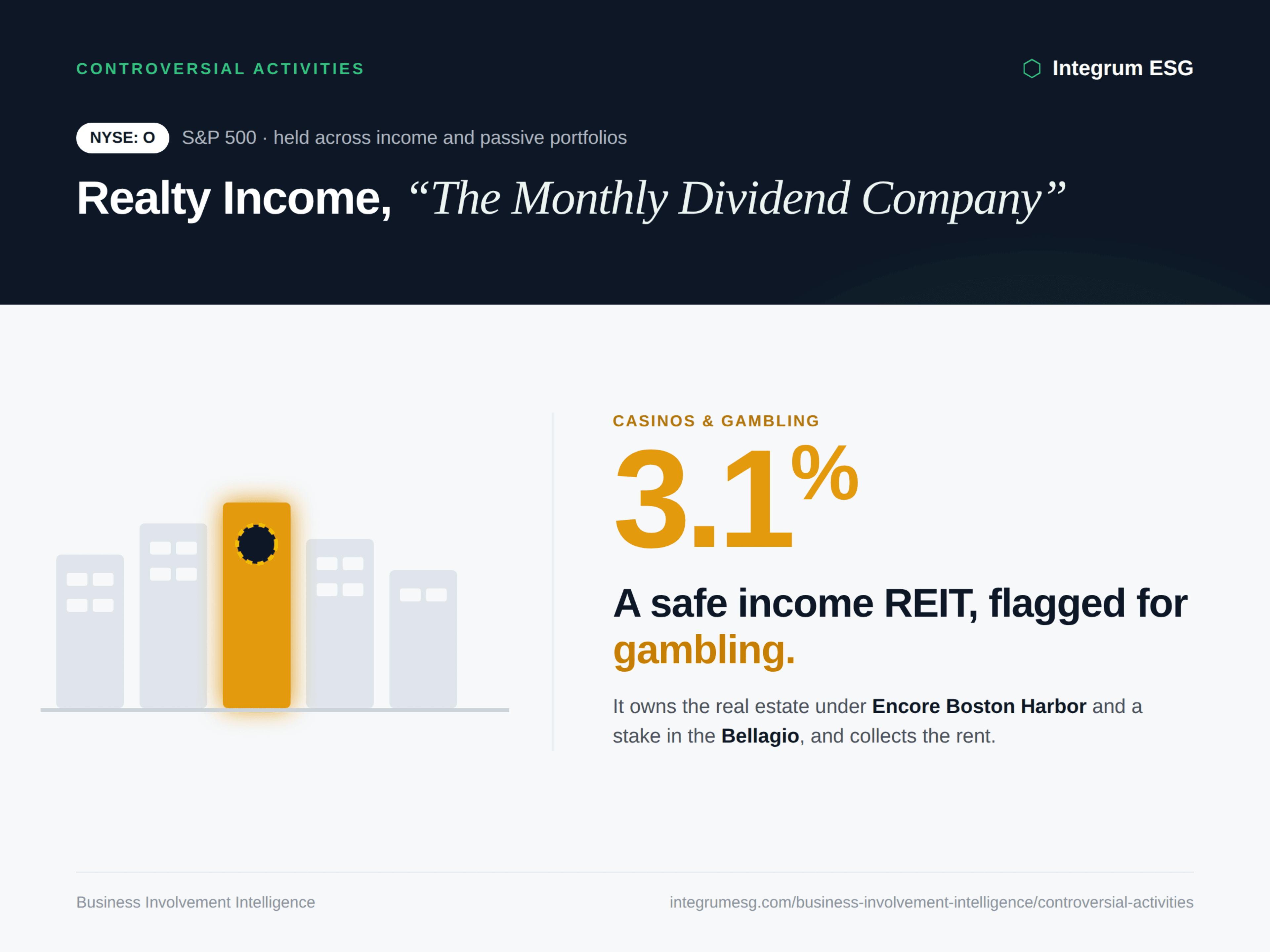
Aristocrat Leisure is among the ten largest holdings in both VanEck funds, and in the UCITS fund it carries a larger weight than Take-Two. Most of its revenue comes from gambling.
Aristocrat reports three segments: regulated land-based gaming machines, social casino games and regulated online real-money gaming. In the year to September 2026, its group revenue was A$6.09bn, of which A$4.02bn came from its land-based business and A$457.2m from online real-money gaming.
Its place in the funds comes down to the index rules. Both VanEck funds track indices that admit companies earning at least 50% of revenue from video gaming or esports and let existing members stay while that share is at least 25%, according to VanEck's US prospectus and the UCITS fund's index description. On those rules, a company can stay in with three-quarters of its revenue coming from elsewhere.
Integrum ESG's Controversial Activities data shows what that means for the funds. It attributes at least 4.9% of the UCITS fund's look-through revenue to gambling and at least 4.3% of the US fund's, about nine-tenths of it through Aristocrat.
Integrum ESG measures more than 50 controversial activities by the share of a company's revenue that comes from each. For a fund, it looks through to the holdings and weights each company's figure by its share of the fund. Gambling is split between casinos and gambling establishments and the supply chain that serves them. Controversial Activities Explained sets out how each activity is defined and measured.
Investors who exclude gambling cannot rely on the fund's own screens. The UCITS fund is classified under Article 8 of the EU's Sustainable Finance Disclosure Regulation (SFDR), a label managers give their own funds when they promote environmental or social characteristics. Its sustainability disclosure excludes companies earning 5% or more of revenue from tobacco, thermal coal, fossil fuels, oil sands, nuclear, civilian firearms or military, along with any company with revenue from controversial weapons.
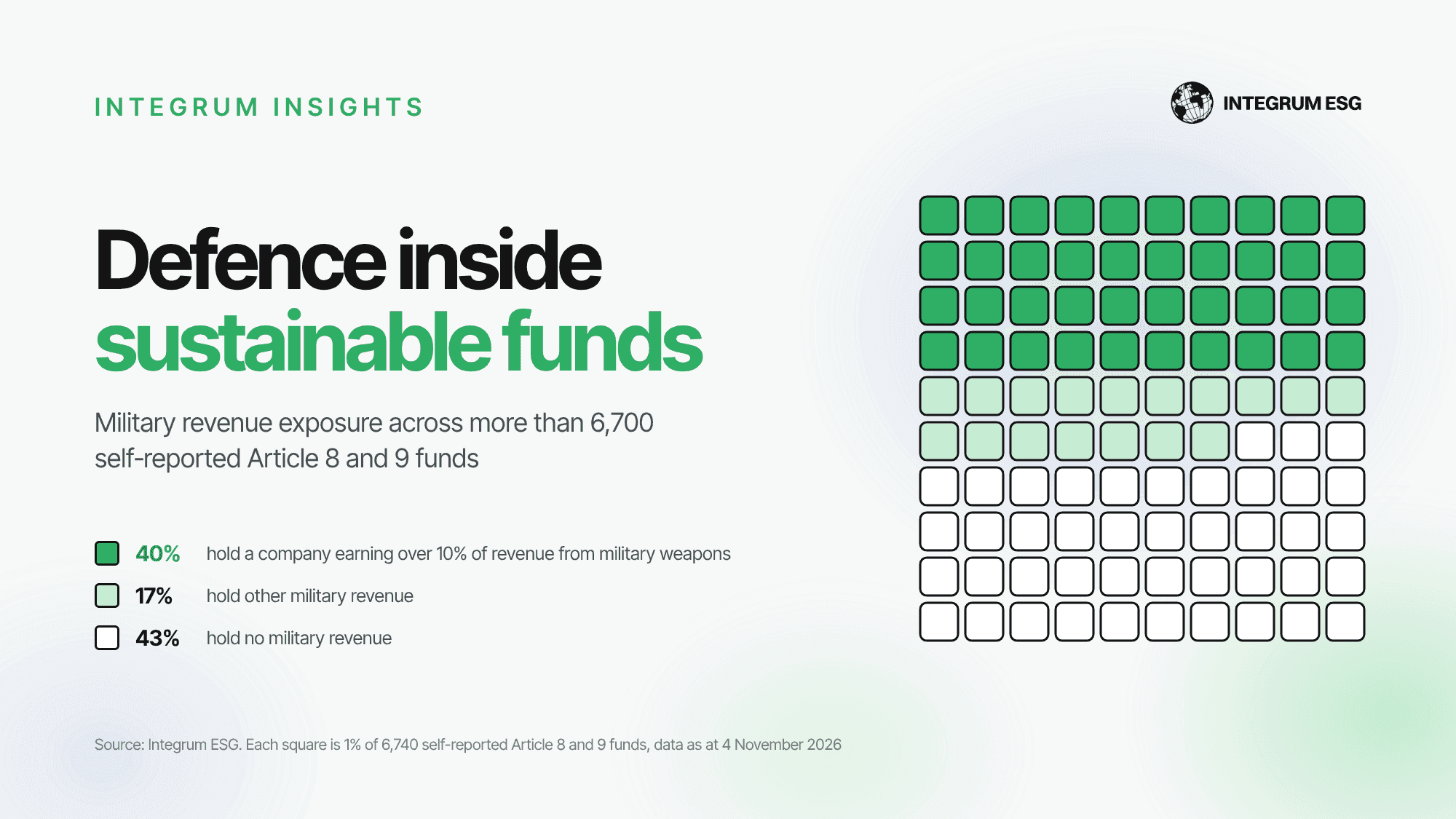
Gambling is listed only as an activity the index monitors, so those investors need to apply that screen themselves. The same check applies to other exposures in Article 8 funds: our analysis of defence exposure in sustainable funds applied this look-through to more than 6,700 self-reported Article 8 and 9 funds.
Take-Two's next quarterly results, covering the three months to December, will be the first to include GTA VI. They will give investors a direct read on how the game sold and how quickly players began spending inside it.
Data security will be harder to judge from those results. Take-Two's only commitment is to disclose material breaches in its SEC filings, so shareholders have no yearly count to track alongside sales. They can ask for one against the SASB metric, as CD Projekt already reports. They can also ask the Technology Risk Committee how Take-Two oversees the suppliers that hold its data, since April's breach came through one.
Fund investors can check more for themselves. A video game ETF's holdings show how concentrated it is, how much sits in Japan and how much of its revenue comes from activities such as gambling. On Integrum ESG's data, all five funds we looked at are more concentrated than MSCI World and score below it. Both VanEck funds carry gambling exposure, and the UCITS fund's exclusions do not cover it.
For investors buying into the launch, directly or through a fund, what Take-Two discloses and what a fund holds deserve as much attention as the sales figures. Integrum ESG's Company Intelligence shows which figures each company publishes and Funds Intelligence shows what sits inside each fund, with coverage of 6mn+ ISINs across companies and funds.
About the data: the company comparison covers companies in the Software & IT Services sub-sector worth $10bn or more that are scored on their own disclosures, as recorded on the Integrum ESG Platform in November 2026. Companies that delist during a financial year remain covered until that year ends. Board tenure is calculated from the dates in Take-Two's 2026 proxy statement.
Speak to an expert about what sits inside the Take-Two and video game holdings in your portfolio.


Browse frequently asked questions about the platform.
Can’t find the answer you’re looking for? Please get in touch with our team.