
Shrey joined the BD team at Integrum ESG in 2025, bringing corporate and institutional relationship management experience. She previously worked at HSBC, where she supported Global Financial Sponsors and Private Equity-backed companies on complex transactions and financial solutions. Shrey holds an MEng in Mechanical Engineering from the University of Bristol and an Advanced Diploma in Banking and Finance from LIBF.
A practical guide to biodiversity risk, TNFD and the core metrics entering investment analysis
For investors asking where to start on biodiversity and nature risk, NVaR is the answer. Here is a practical guide to what it measures, how it works and where to access the data.
Short on time? Speak to our team to understand how biodiversity risk can be quantified across your portfolios.
Most investors understand that biodiversity and nature risk is material. Fewer know how to put a number on it.
Nature Value at Risk (NVaR) is a financial metric that quantifies how much of a company's production and revenue could be disrupted under severe ecosystem degradation scenarios. It translates a company's dependencies on nature - water supply, stable soils, flood protection, climate regulation and pollination - into a comparable, portfolio-ready risk signal.
When ecosystems come under stress, the companies that depend on them face real operational and financial consequences. NVaR makes that exposure visible and measurable.
The output is a headline metric and a structured breakdown showing what is driving risk, where it sits geographically and how material it could be in financial terms.
It can be applied consistently across companies and portfolios.
The NVaR framework is built on a straightforward structure:
NVaR = Potential Loss x Exposure
Potential loss captures how severely ecosystem disruption could affect a given sector in a specific location. Exposure reflects how much of a company's economic activity takes place there.
Potential loss is determined by three factors:
These inputs are combined to estimate production disruption risk, then multiplied by a company's actual activity in each relevant location.
NVaR is calculated across both direct operations and supply chains. For many companies, significant biodiversity risk sits upstream through sourcing networks rather than in their own facilities.
The framework accounts for both channels and keeps them separate, since they imply different risk management responses.
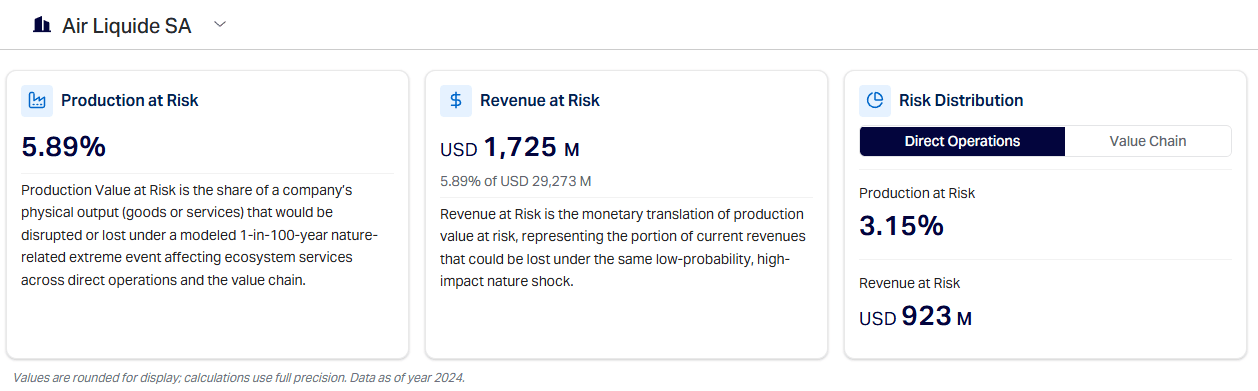
Take Air Liquide SA [AI.PA], the global industrial gases company, as an example.
The NVaR analysis shows 5.89% of production at risk and USD 1,725M of revenue at risk under severe nature-related disruption scenarios.
Two expressions of the same underlying calculation: one as a share of output, one translated into financial terms.
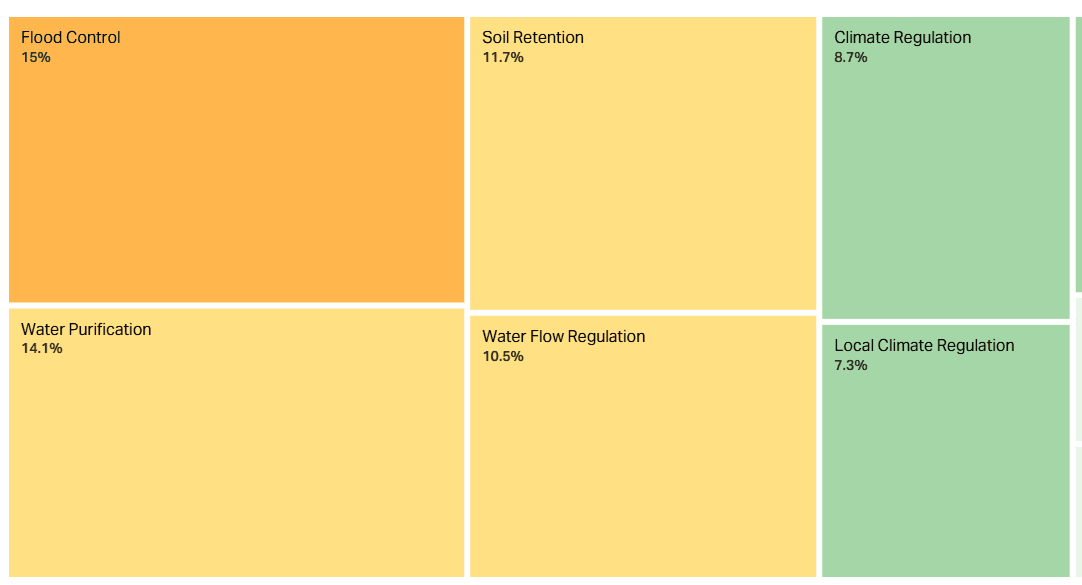
The data then breaks down what is driving that exposure. For Air Liquide, flood control and water purification are the two largest contributors to nature risk, reflecting the water-intensive nature of industrial gas manufacturing.
This is where NVaR moves from a headline figure to something actionable - it identifies which ecosystem services matter most for a given company.
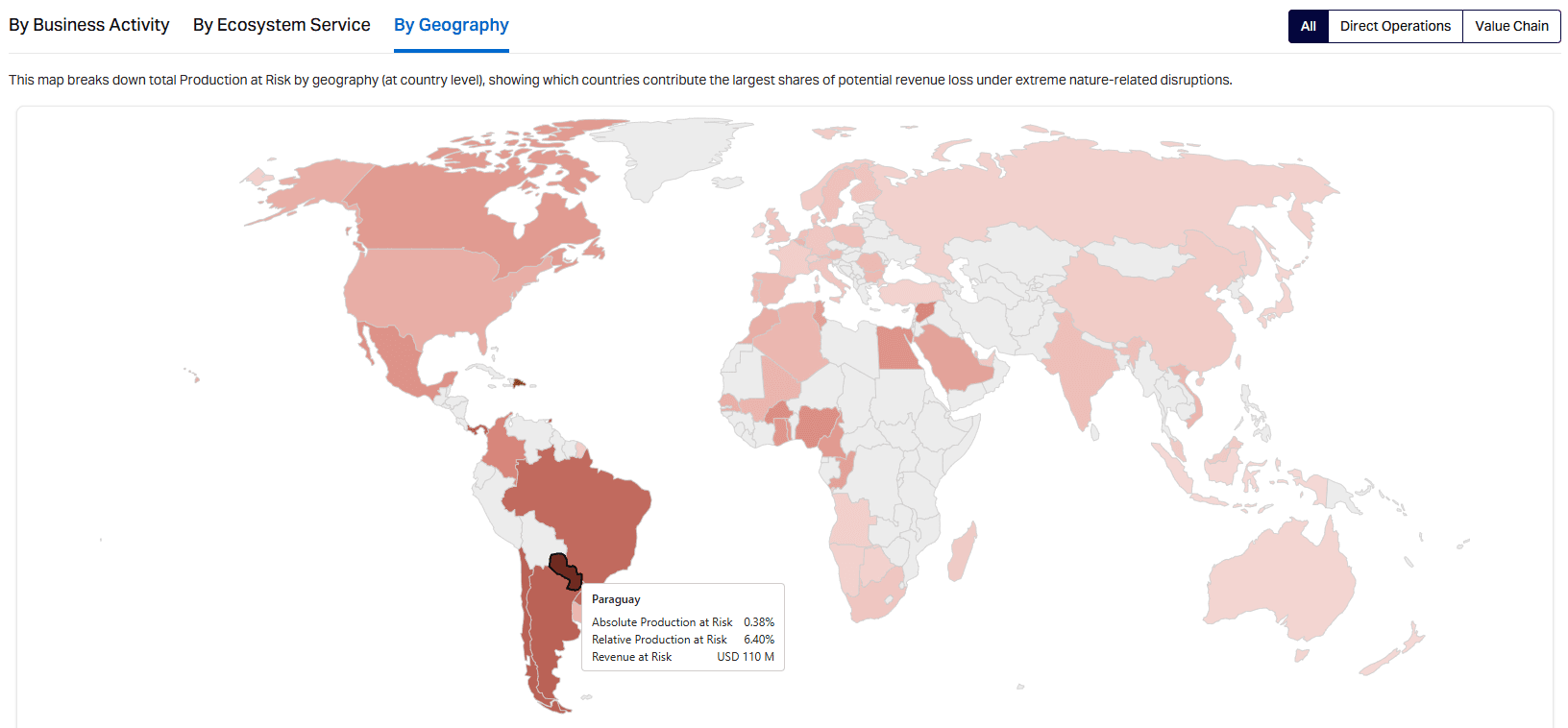
The geography view shows where that risk is concentrated.
Latin America emerges as the key hotspot, with Paraguay carrying production at risk of 6.40% and USD 110M of revenue at risk in that geography alone.
Biodiversity and nature risk is broad and the frameworks around it are still developing.
As TNFD adoption accelerates and regulatory expectations around nature-related disclosure grow, investment teams face increasing pressure to demonstrate that nature risk is reflected in their analysis - but knowing where to begin remains a genuine challenge.
NVaR cuts through that complexity:
It speaks the language of investment risk.
NVaR is expressed as a share of production or revenue at risk. That makes it immediately comparable to other financial risk metrics and straightforward to integrate into existing frameworks.
It scales across portfolios.
Because NVaR can be calculated consistently across thousands of companies it can be applied at portfolio level without bespoke analysis on every holding. Investors can screen for nature and biodiversity risk quickly and identify where exposure is most concentrated.
It explains what is driving risk.
NVaR breaks down exposure by ecosystem service, geography and business activity. That granularity supports stewardship, materiality assessment and ongoing monitoring, not just initial screening.
It supports TNFD alignment.
NVaR maps directly onto the dependencies and risk assessment pillars of the TNFD framework, giving investment teams a defensible, data-driven foundation for nature-related disclosure.
For teams beginning to integrate biodiversity risk into investment processes, NVaR provides a clear and credible first step.
At a company level, NVaR answers: how exposed is this company's production and revenue to nature-related disruption?
At a portfolio level, NVaR answers: where is biodiversity risk concentrated across my holdings, what is driving it and how material could it be?
Both views share the same underlying structure - geography, sector, ecosystem service, risk channel - meaning insights at the company level translate directly into portfolio-level analysis.
NVaR is available directly through the Integrum ESG Platform as part of our Biodiversity Intelligence dataset.
Biodiversity Intelligence, powered by GIST Impact, includes nature and biodiversity analytics covering more than 18,000 companies with data going back to 2016.
The NVaR calculation is built on granular asset-level location data, sector-specific ecosystem dependency analysis and a clearly documented methodology drawing on leading research including from the Network for Greening the Financial System.
Investment teams can access NVaR alongside the broader suite of ESG intelligence on the Platform, integrating it into existing workflows for monitoring, due diligence, benchmarking and reporting.
Find out more about Biodiversity Intelligence and what is available through the platform.
If you want to see NVaR applied to companies you hold or are evaluating, our team can run the analysis and walk you through the results.
Book a call with the Integrum ESG team to get started.


Browse frequently asked questions about the platform.
Can’t find the answer you’re looking for? Please get in touch with our team.